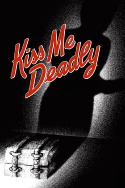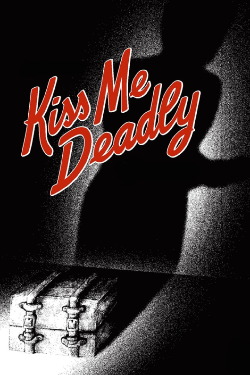
Review of Kiss Me Deadly (1955) by Adam R — 09 Sep 2011
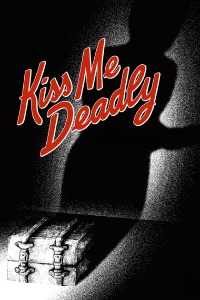
Remembered primarily for its almost gleeful, excessive (for the time) violence and hysterical ending, "Kiss Me Deadly" is by no means the best film noir ever created but it is an interesting look at how the genre had developed since the preceding decade of Sam Spade and Philip Marlowe.
Mike Hammer (Ralph Meeker) is a brutish, gutter-dwelling dick who specializes in "penny-ante divorce cases." He stumbles on something bigger -- and, he hopes, more profitable -- after picking up a young woman wearing only a trench coat (Cloris Leachman) seemingly embroiled in something big and dangerous. Unfortunately, before he can get more information from the woman, Hammer and the woman are captured and she is killed (cue vaginal torture death scene); "Deadly" is a rare film noir where the hero is as much on the receiving end of violence as the violence he dishes out.
In typical shamus fashion, though, Mike can't stay away from a case where everyone, his faithful, put-upon assistant Velda (Maxine Cooper) included, keeps telling him to stay away from. Plus, it might prove profitable and the P.I. gets to romance dim blond Lily (Gaby Rodgers), the roommate of the woman Mike met on the road, and match wits with two brutal if not particularly bright heavies played by Jack Lambert and the crazy-eyed, reliably weird Jack Elam.
"Deadly" supplants the subtle dread and issues of conscience of the '40s with characters primarily occupied with their own advancement, director Robert Aldrich going to great lengths to depict just how far and how many lines they're willing to cross to get that piece of the pie. Hammer and the people surrounding him are reflective of a post-War underclass; they've seen their world turned upside-down and practically destroyed, making things like "honor" and "justice" vague concepts that hold very little value on the streets. The horrors of World War II and the lingering dread of the Cold War make them acutely aware of the value of "now," of getting what they want before it's too late.
One of the best things about the movie is Aldrich's ability to jolt audiences with just how quickly death and dismemberment can come in Mike Hammer's world. Apart from Leachman's remarkably ahead of its time torture death, we also see Mike's de facto sidekick Nick (Nick Dennis) get crushed by a car lowered from its hydraulic lift and Hammer himself smash the fingers of an oily doctor in a desk drawer. Hammer himself is the victim of violence a total of six times, making the capriciousness of life and crime (as noted by "Detour's" Al Roberts) palpable.
So if "Deadly" is so adept at creating atmosphere, why is it no masterpiece of the genre? To be frank, the movie's ridiculous. The dialogue frequently moves across the line from highly stylized to half-baked (particularly everything said by Nick, the only likable character apart from the fact that he's a massive, one-dimensional stereotype, and an absurd scene near the end of the film in which Lily "reveals" both her true nature and Mike's) and the era's predominant symbolism -- the threat of nuclear annihilation -- becomes more overcooked the more it takes center stage (just like it usually did with any movie made during the long, drawn-out pseudo-battle royale with Russia, which had a pernicious effect on national morale but an even more deleterious impact on movies' ability to use subtlety). Worst of all, Mike Hammer is an empty vessel. He has no defining characteristics, save for a way with the ladies, blatant self-preservation instinct and a propensity to take a little too much pleasure in dishing out violence on others, meaning he stays a cipher while wandering through a pre-dystopian Los Angeles filled with set pieces and cracker-thin thugs and dames meant to pass for characters.
Mike Hammer author/creator Mickey Spillane might have seen the post-War world as soulless, and Aldrich and his cast certainly agreed, but they all could have made their thesis a bit more convincing and involving than this. As it stands, "Deadly" is an exceptionally well-made cardboard cut-out of a mystery film, its fractured storytelling and lifelessness plastered over by shallow characters and just enough subtext for most critics to all-too-predictably sink their teeth into while ignoring the flaws.
This review of Kiss Me Deadly (1955) was written by Adam R on 09 Sep 2011.
Kiss Me Deadly has generally received very positive reviews.
Was this review helpful?