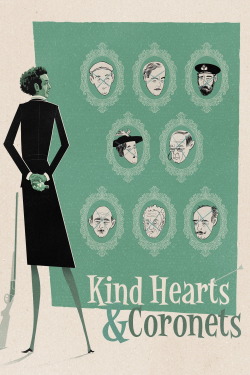
Review of Kind Hearts and Coronets (1949) by Lasse C — 08 Apr 2010
Actually, He Played Everybody!
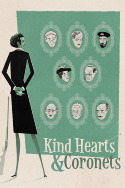
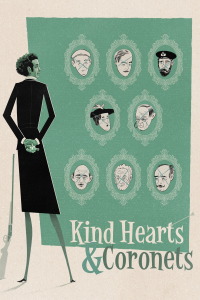
The title, of course, refers to a poem by Alfred Lord Tennyson which informs us that the former is worth more than the latter. The implication, I rather suspect, is that Our Narrator, Louis Mazzini (Dennis Price), devalues himself over the course of the film. His determination to avenge the wrongs he feels, not without justification, to have been dealt make him do things no sane person would do. All the funnier that he declares that he won't actually shoot anything while his uncle (or something) does, because he won't participate in such bloodsport. It was said at one point that they were trying to sell irony, and that never worked, but what with one thing and another, this is still considered one of the greatest British films of all time.
Louis's mother (Audrey Fildes) married an Italian tenor for love. Her aristocratic family turned her out because of it, and even when her husband died on the day her son was born, they wouldn't take her back. She raised her son on this resentment, making sure he never forgot how close he was to the Dukedom of Chalfont. (Due to complicated legal maneuvering explained at the beginning of the movie, inheritance is, in this family, possible through the female line even in 1900.) When his mother dies, it boils over--the family won't let her be buried in the familial plot. Louis decides he has had enough, and he is going to claim his inheritance if it means killing every single D'Ascoyne (Sir Alec Guinness) standing in his way. This is complicated by his relationship with childhood friend Sibella (Joan Greenwood), who married someone else when she thought he wouldn't amount to anything, and his interest in the widowed Edith D'Ascoyne (Valerie Hobson).
And don't those D'Ascoynes drop like flies! The Admiral dies in a naval accident, apparently based on a real event, and the Banker is weakened by a stroke and then has a heart attack upon discovering his inheritance of the title. However, in one way or another, Louis does away with the other six. While there are at least two cases I can think of which should have borne investigation, in one of those, there's no reasonable expectation that anyone ever would have been convicted, or even accused. Lady Agatha D'Ascoyne, the suffragette, is in a balloon flying over London, and it is . . . damaged. This would be, to me at least, obviously murder, given how it's damaged, but also given how it's damaged, she would just be a martyr to the cause, and there is no possible way of figuring out exactly who martyred her. And that is one of the pleasures of the various plots; the ones which couldn't be seen as accidents or natural could almost never be traced to him, except maybe the last one.
The Duke tells Louis that he's quite obviously insane, and for once, I agree. "Insane" has a very specific meaning and isn't the same as just crazy or even mentally ill. You see, at no time over the course of the story does Louis ever really consider that what he's doing is wrong. They wronged his mother, and therefore, they must pay. The lot of them. One of them even complains about some man who asked that his mother be allowed to be buried there, not realizing that it was Louis and that his mother had been a D'Ascoyne. And, yes, those with any responsibility should have had to face it. I just don't think most of them had anything to do with it or possibly even knew what was going on. Even if they had, being murdered was not going to bring Louis's mother back or make them sorry for what they did to her. However, once he's set on his goal, Louis doesn't even really seem to consider that. He's decided that they must die, and so they do. He's only glad the the Banker, whom he actually likes, dies of natural causes before he's forced to murder him. There is, however, as close to no doubt as matters that he would have done so had the Banker not had his heart attack.
Peter Sellers quite famously told Jim Henson that, while he could be Queen Victoria, he didn't know how to be himself. (So they dressed him up as Queen Victoria.) Sir Alec didn't have that problem. The problem he did have was that he knew he wasn't Obi-Wan Kenobi. He hated it. He hadn't liked the movie while he was making it, though his costars say he was polite enough so that you wouldn't know it. The only thing he liked about it, from what anyone can tell, is that he was about the only person confident it would be a hit, so he managed to negotiate himself 2% of the gross. He didn't, after that, have to do "the money, dear boy" movies. He and his wife, who were married for sixty-two years, were able to live happily, if modestly, on that. (And how modestly probably depends on your definition.) It broke his heart that, after all that--unto an Oscar for a movie he was actually proud of--people thought of him in the Mos Eisley Cantina.
This review of Kind Hearts and Coronets (1949) was written by Lasse C on 08 Apr 2010.
Kind Hearts and Coronets has generally received very positive reviews.
Was this review helpful?