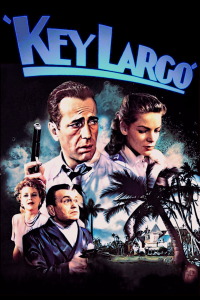
Review of Key Largo (1948) by Devin R — 21 Feb 2008
I think "Key Largo" is a level below the best work of John Huston - for me, it doesn't quite measure up to the likes of "The Maltese Falcon", "The Asphalt Jungle", or "The Treasure Of The Sierra Madre". Yet, the film is still very well done, a crime thriller with noir influences. "Key Largo" isn't really a film noir, though - too much of a happy ending, and the story is dominated by the villain. The villain in this case is Edward G. Robinson, of whom I am a huge fan, and I think this is one of his greatest performances. His performance, especially when walking around in the bar with a crazed look on his face at the height of the storm, is amazing at all turns and he is the engine that makes this movie go. Lionel Barrymore as the wheelchair-bound father and Claire Trevor as the alcoholic ex-singer are also noteworthy. Less noteworthy for me were ostensibly the two leads - Bogart and Bacall (this would be their last film together). Their performances suffer for having little to do (especially Bacall), while Robinson walks off with the movie. Although Bogart takes centre stage in the film's final scenes, he doesn't have much of a role in the rest of the film.
However, "Key Largo" does not suffer all that much. This movie is about mood, place, time, and setting. The film was made three years after the end of World War II, in which the director served with the American army as a documentary filmmaker. The war hangs over the film like an ominous shadow, and the hurricane which strikes the hotel (sorry for revealing if you haven't seen the film) is symbolic of the chaos and furor of the war - from which Bogart's character is a returning veteran. The war is continuously referred to throughout the film, noticeably more so, I thought, than in other post-war noirs/thrillers that I have seen. It is an ominous presence, and as symbolized by the hurricane, threatening and destructive.
The best part of "Key Largo" is that this turmoil is played out psychologically, not physically. Bogart and Robinson play mind games with each other throughout the film, and the scene with the empty gun is a classic example of that. Robinson plays mind games with just about everyone, being particularly cruel towards his girlfriend. Watching this psychological warfare play out is the highlight of the film. John Huston was a master at this sort of thing - I recommend seeing "The Maltese Falcon" and especially "Sierra Madre" for more amazing examples of this.
The buildup of tension throughout is very good, and the special effects shots of the hurricane's attack on the hotel provide terrific punctuation marks. Yet, the ending didn't feel right to me - too much of a Hollywood ending for me. Given what I've seen of Huston's work, I suspect he didn't like it much either. Drawing it out like he does, it seems like he is toying with the idea of having the bad guys win, but at the last second the hero pulls through. I know that's how most Hollywood endings work anyway, but it felt different here, as I half expected some sort of disaster to befall the hero. Of course I wasn't crushed or anything when that didn't happen, just a little disappointed. Otherwise, "Key Largo" is certainly a well-done entertaining thriller - but it does not represent the best work of John Huston.
This review of Key Largo (1948) was written by Devin R on 21 Feb 2008.
Key Largo has generally received very positive reviews.
Was this review helpful?