Review of Juliet of the Spirits (1965) by Robben M — 23 Sep 2009
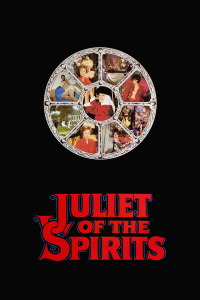
Juliet of the Spirits? Or Simon of the Desert? Aside from the very obvious Luis Bunuel influences in Federico Fellini's glowing techinicolor masterpiece, JULIET OF THE SPIRITS is one of the most mysterious movies ever made.
Some might think that infers it's meaningless and therefore, worthless. Not exactly. While definitely not meaningless, it is a stream of consciousness events that depict the strange going-ons of a posh, lonely upper-class housewife named Juliet. Played by Guilietta Masina (Fellini's wife), she is always distant, completely unaffected and carries a strangely contented smile on her face at all times.
Despite this, we see a freakish depiction of the rich, even weirder than the climax in La Dolce Vita. Juliet is waiting for her husband to celebrate their anniversary. After going through all manners of wigs, she picks her favorite, a brown colored wig. Her clothes on the other hand are finely embroidered and her maids spend time trying on their mistresses many fancy hats.
But her husband has completely forgotten about their annversary...or has he? For whatever reason, a large group of people are waiting right outside, on the front lawn, standing completely still, moving only when they are acknowledged. Surrealist touch? Or the cracks of Juliet's reality already crumbling? It doesn't matter.
From here on out, we meet Juliet's bizzare neighbors, all of whom indulge in sophisticated small talk, pretending to be deep and artful. Her neighbor is a neurotic housewife, much like herself, though her friend is massively insane, and is dressed up like a present box. However, because everyone is leering and deatched, Juliet's neighbor seems downright sane. That is, until she meets Suzy, the mysterious and welcoming tart who has hordes of lovers of both sexes.
The epynomous spirits are either real or demons from the past. Because the film is opaque and enigmatic, we are never sure what to think of the barrage of images and figures that startling appear in bravurra moments.
At one point we actually see Simon of the Desert from Luis Bunuel's black and white short film, though because this is Fellini, he is shown with a flaming red beard. Perhaps appropriately, we discover that this Simon is actually modeled on Juliet's tyrannical Sunday school teacher who likes to stage plays about martyrs burning on grills played by children.
Juliet's father was not pleased. And then we travel to the past and see a little of how Juliet became the way she is. We see the woman her father ran off with, looking suspiciously similar to Suzy (actually, it's the same actress...and Juliet's father is both older and looks like a friendly, bearded Fellini. Hmmm...) and we meet Juliet's mother, who, much like Juliet herself, is a distant, seemingly contented and completely ice cold woman.
What does this all add up to? There is a running plot through the film, that of the lingering question of whether or not Juliet's husband is cheating on her, but it's almost secondary to the textures and colors that Fellini arranges to confuse the audience into wondering, what is the spirit world and what is real? Is it sanity, insanity? Fantasy, reality? Does it matter? Is it symbolic? Metaphoric about female independence? Male masturbations projected onto Fellini's wife playing a housewife who seems to be modeled on Giuliuetta herself?
If we knew, this film would be much easier to crack, but alas, it is the most opaque of Fellini's movies, and he probably recognized this, since all his subsequent films are much more direct.
It doesn't matter. Juliet of the Spirits is pure cinema. It's definitely the most difficult of Fellini's movies, if only because he spends such a great deal of time lingering on ordinary moments and making them strange, or taking the strange and integrating it into an already artificial world (check out the feet and feet of astroturf that is Juliet's front yard).
Matters are made more surreal by the addition of Nino Rota's almost light and cheery score that bounces along, seemingly oblivious to the events going on in the movie. When Juliet has one of her psycho-supernatural episodes, Rota's happy sounding dance theme plays, completely in-appropriate, and yet, it makes sense.
It's like someone stuck in two worlds. Juliet is stuck in two worlds, but not of sanity and insanity, but one of the rich and liscentious (Suzy is not the answer if that's what Fellini thinks you're assuming) and the free and liberated (which is what Juliet's father took, literally escaping in a bi-plane with an idealized Suzy in the form of the circurs dancer).
But the ending never makes things clear. Is Juliet insane? Will she go off and join the spirits in the forest? Or is it simply fellini being a trickster and deciding that he will ruin our revelries by frustrating us some more?
The answer, not surprisingly, is a combination of all the above.
Whatever it is, Juliet of the Spirits is Fellini's most daring and experimental films.
This review of Juliet of the Spirits (1965) was written by Robben M on 23 Sep 2009.
Juliet of the Spirits has generally received very positive reviews.
Was this review helpful?