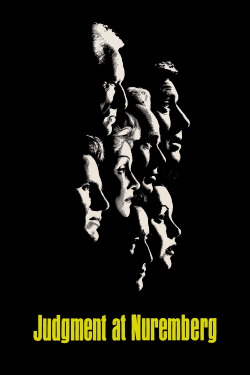
Review of Judgment at Nuremberg (1961) by Joe C — 22 Jun 2010
Spencer Tracy channels a refreshing patience in his role as a humble American judge shipped over to don the gown of chief justice in a military tribunal comprised of judges facing judges. Clearly, the scales should be balanced. He and his fellow adjudicators sit across the room from an even number of other adjudicators. One would think they would all see eye to eye. And yet, Tracyâ??s Judge Haywood of Maine finds himself indecisive of how four respected judges like himself could have passed sentences resulting in genocide, sexual sterilization, abiding laws having more to do with â??racial defilementâ?? and ultimately, how an entire country of people could be permissive of these atrocities. The film is a teeming, deliberate process of him making up his mind.
The black and white cinematography emphatically reflects the utter formality and procedure of the courtroom environment. Each and every shot is perfectly balanced in equal terms of space, single or overlapping planes and converging focus. There is a shot that is repeated constantly, the slowly revolving camera fixed on its subject then eventually stopping and crash-zooming into that character at a point of rising vigor in his or her monologue. The shot is very effective, but the repeated use of the sudden crash-zoom, rather than being used once or even twice at the most, begins to feel rather arbitrary. Why this point in a speech rather than that point in the speech?
Burt Lancaster, though sounding quasi-transatlantic and staccato rather than donning an actual German accent, has the still and silent ferment that brings the symbolic purpose of his character to full impact. For two hours, he remains almost completely silent and relatively motionless; in the third, he accosts us with one of the most telling, socially aware and discomfortingly honest monologues ever performed on film. The reason I suspect his character is a symbol is because his omnipotent speech condemning himself and his fellow defendants for complicity in the Third Reich, that itâ??s not that they didnâ??t know the truth but that they didnâ??t want to know the truth, something that human nature tells us must have been and might still be a feeling that runs right to the existential core of many German people. And yet it doesnâ??t stop there: Why do we Americans support our leaders in punishing minorities, preemptive attacks, an ever-deepening divide between rich and poor? When Lancaster is finished, in another of Stanley Kramerâ??s blatant demonstrations of balancing scales, Schell follows his defendant by raising issues such as Winston Churchill's words of praise for Hitler, the Vaticanâ??s platform not only of uninvolvement but approval. He also mentions earlier the support of an American Supreme Court justice, Oliver Wendell Holmes, for the practice of eugenics.
It is difficult not to feel a strong connection to Judy Garland as Maximilian Schell is cross-examining her. She bares such a pitiful vulnerability and nearly crumbles before our eyes. In a movie constructed mainly of prolonged scenes of extensive monologue, this scene is comparatively not very long, and yet it provokes an emotional impact unique to any of these other powerhouse scenes. The point of it, seemingly, in the larger scope of the film, is not merely her agony but Schellâ??s ruthlessness. And in even broader terms, we find that despite Schellâ??s brutally controlling provocation of the witnesses, he is not a monster but a really good defense attorney, as well as a man of logic fully aware of his function in this courtroom and as a human being battling his inexorable personal stakes in the guilt or innocence of his defendants.
Indeed, no central character is a hero or a monster. No one entirely understands the macrocosmic fulcrum in which theyâ??re entrenched. One may find that the scenes outside the courtroom are dull by comparison, that they could be dispensed with to streamline the action, mainly the scenes where Haywood befriends a level-headed German war widow played by Marlene Dietrich, who gives him her perspective on the war. But in a film constructed completely on counterweight and parallels, there must be Germans who caused suffering, and Germans who were caused to suffer. Just as there are evenhanded Americans like Haywood and vengeful gung-ho Americans like Richard Widmarkâ??s prosecutor.
The nature of Montgomery Cliftâ??s posture, his utter wariness against the past, his debilitating anxiety and feebleness, the texture of his accent, is entrancing. Perhaps itâ??s distasteful to suggest that his deteriorating health and looks resulting from his mid-1950s car wreck was a positive inducement in his later performances, but in this case, I believe that because we associate him with the sublimely handsome young man of I Confess and A Place in the Sun, there is something so tragically off-kilter about him here. But it is not merely the post-accident physical impact, it is just as much the devastating vulnerability he carries from a truly pain-filled life that he dauntlessly brings to his astonishing early scene as a truly sympathetic character if there ever was one.
The movie is massive in the breadth of its questions of individual complicity in government crimes. Where is the end to the blame? There is no doubt that the men on trial here are guilty. They supported a bigoted, oppressive war machine. But then that must mean that those who supported the men on trial are guilty, and also their supportersâ?? supporters, and so on. What we find at the roots of these apparent sometime advocates of Hitlerâ??s regime is altogether a stockpile of rationalization and justification deriving straight from nationalistic pride. â??Above all, there was fear,â?? Lancasterâ??s Ernst Janning defiantly divulges. â??Only when you understand that can you understand what Hitler meant to usâ?¦What about those of us who knew better? We who knew the words were lies and worse than lies? Why did we sit silent? Why did we take part? Because we loved our country! What difference does it make if a few political extremists lose their rights? What difference does it make if a few racial minorities lose their rights? It is only a passing phase. It is only a stage we are going through.â?? And so on.
It isnâ??t just mammoth monologues that gush with subtext, it is also single-sentence replies, such as when Haywood is told, â??Those millions of peopleâ?¦I never knew it would come to that,â?? to which he responds, â??It came to that the first time you sentenced a man to death you knew to be innocent.â?? The fact that the film ends on that line is a clear alarm bell that this film is not merely an indictment of the Nazis, but the severest warning to all human beings of judiciary and legal positions everywhere. I know that itâ??s become a tired old hat trick to compare any political state of affairs you donâ??t like to Hitlerâ??s Reich (Iâ??m talking to you, Beck), but letâ??s be realistic here: What does one think will happen if a governmentâ??s legal system secures patriotism and nationalism as higher obligations than pure justice?
This review of Judgment at Nuremberg (1961) was written by Joe C on 22 Jun 2010.
Judgment at Nuremberg has generally received very positive reviews.
Was this review helpful?