Review of Joy Division (2009) by Mel V — 20 Mar 2008
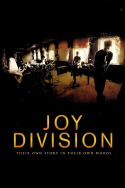
Joy Division, the post-punk Manchester band, will be forever associated with lead singer/songwriter Ian Curtis? untimely death on May 18, 1980. Curtis, clinically depressed, emotionally conflicted, and physically ill (he suffered from epilepsy) committed suicide on the eve before Joy Division was to embark on its first tour of the United States, as the supporting act for another post-punk band, the Buzzcocks. Curtis was 23 when he died. Curtis? tortured, introspective lyrics and the band?s dark, atmospheric sound made him a perfect example of the romantic, tragic hero. Last year, Anton Corbijn made Curtis the focus of his bio-doc, [i]Control[/i]. Almost simultaneously, Grant Gee directed and released [i]Joy Division[/i], a documentary chronicling Curtis? all-too-short, brilliant life and with it, Joy Division?s equally short, brilliant life as a post-punk band that?s just as listenable now as they were almost thirty years ago.
A traditional documentary in format, [i]Joy Division[/i] exhaustively covers everything related to Joy Division, how the Manchester band formed, the socio-economic conditions of late 70s Thatcherite England, the early punk scene, the missteps and mis-starts, the band?s early successes, their first, fateful meeting with Tony Wilson, the late television personality who founded Factory Records in part to release Joy Division?s first album, [i]Unknown Pleasures[/i], Curtis? marriage, his intellectual curiosity and interest in poetry and literature (e.g., Rimbaud, Kafka), his relationship with Annik Honore, a Belgian journalist he met while touring Europe, Curtis? battle with epilepsy, his clinical depression, and ultimately, his suicide.
The interviews include Tony Wilson, who died last August of cancer, to Curtis? fellow band mates, Peter Hook (bass guitar and backing vocals), Stephen Morris Stephen Morris (drums and percussion), and Bernard Sumner (guitar and keyboards). After Curtis? death, the surviving members changed the band?s name from Joy Division to New Order, which went on to become commercially successful as an electronic-pop band. Deborah Curtis, Ian?s wife, doesn?t appear onscreen, however. Excerpts from her book about her life with Ian are read at key points during the documentary. Also interviewed for the documentary are Genesis P-Orridge (as Genesis P. Orridge) , the lead singer/songwriter for Psychic TV, and Pete Shelley, the singer/songwriter for the Buzzcocks.
Key to the documentary is, of course, the realization and the recognition that Curtis, for all his contributions as singer and songwriter, was still just one member of Joy Division, each with their strengths as musicians, each with something to contribute to Joy Division?s unique, genre-bridging sound. Gee gives Joy Division?s producer, Martin Hannett, an inveterate tinkerer, credit, however, for pushing Joy Division away from a ?pure? punk sound to a sound that married traditional rock instruments (guitar, bass, drums) with keyboard synthesizers and in-studio, electronic manipulation that ultimately defined Joy Division as a post-punk band. Gee also gives the late John Peel screen time, albeit through archival footage. Like Wilson, but to a lesser degree, Peel helped to champion Joy Division during their early days.
Outside of the reminiscences, some insightful, a few not, and the straightforward, chronology history of Joy Division and Ian Curtis (you can?t have one without the other), most worthwhile, there?s another, it?s the archival footage Gee amassed, collated, edited, and integrated into the documentary that makes [i]Joy Division[/i] worthwhile and not just for longtime fans of the band eager to learn more (Wikipedia can help you there, if you?re interested). As a performer, Curtis mesmerized audiences with his Jim Morrison-influenced vocals, his gestures, and his body movements (some of which resembled an epileptic fit). As he was transported into a seemingly transcendental realm, he took audiences with him. Few performers can claim that kind of shaman-like ability and at least with [i]Joy Division[/i], the evidence is there for you to decide for yourself.
This review of Joy Division (2009) was written by Mel V on 20 Mar 2008.
Joy Division has generally received very positive reviews.
Was this review helpful?