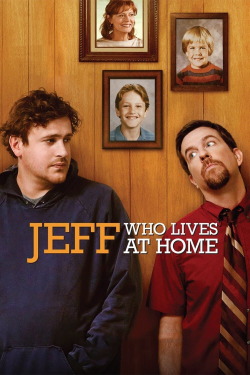
Review of Jeff, Who Lives at Home (2012) by Shiira — 19 Apr 2012
Outside the Hooters, Jeff refers to his old religion, defends it even, when Pat, the elder brother, makes fun of its chief prophet, Yoda, by arguing that the Jedi "would be killer in a business meeting.
" Now, he's a prophet himself, offering up his own commandment, adapted from a precursive faith(just like how Indian religions influenced Christianity), at the outset of Jeff Who Lives at Home, where his words to live by are superimposed over the black screen.
According to the couch potato oracle: "Everyone and everything is interconnected in the universe. Stay pure of heart and you will see the signs." For Jeff, it's the M. Night Shyamalan film, and not Star Wars(see Patton Oswalt in Failure to Launch) that he **** beyond all reason, thereby transforming the filmic text into a quasi-religious object, more powerful than the Holy Bible.
Stoned and disaffected, Jeff elaborates on the spirituality which flows through Signs, and its argument for predestination, making the audience cognizant of the fact that for all intents and purposes, our hero lives "in a galaxy far, far away," a galaxy where Graham Hess, a Pennsylvania farmer, becomes his own personal Luke Skywalker.
Jeff doesn't "use the Force" anymore, instead, he tries to "see". His proclamations, however, are hard to take seriously, unless you believe that all the great philosophers do their best thinking just before they flush.
Ironically, because Jeff starts his morning off mired in a marijuana haze, he misses the first sign, when Sharon calls her adult son to remind him about purchasing some wood glue for a minor home repair.
In essence, Jeff Who Lives at Home is a stoner retelling of Signs. It's not God, but Shyamalan, who is in the details, starting with that open space where the closet door slat should be. The slats resemble the wooden boards in miniature, which the Hess family uses to seal themselves off from the doorknob-challenged aliens.
Like the closet, the window that Graham reconfigures into a component of his impromptu fortress, is also missing a piece of wood, initially anyway, before the ex-Episcopalian minister nails the final board into place, without realizing how his remedial carpentry is part of a master plan.
The pot induces in Jeff a selective cognizance. He catches the second sign, a wrong number, a man on the other end of the line who asks for Kevin, which Jeff translates from the sacred composition and dialogue of the Shyamalanian diegesis into a real world miracle.
Whereas Graham broached the idea of there being no coincidences, Jeff appropriates this posited precondition of a world affected by metaphysics with the suggestion that there "are no wrong phone numbers.
" This epiphany directs the true believer to pen and paper, an endeavor that leads to another sign, when he discovers in the name Kevin, a notable, albeit imperfect, anagram: "knive". An "s"(for signs?) completes the emerging plural, and makes a sort of intertextual sense, since both the titular character from Cyrus(another mama's boy rendered by the same filmmakers) and Graham handle knives in an ambiguous manner.
The supposed weapon is employed as a utensil for slicing bread in Cyrus' hands, while Graham uses his knife as a mirror, when he tries to glimpse the creature on the other side of the pantry door. The anagram's significance probably becomes self-evident to Jeff as he explains to Pat the logistical problems of knocking down a door(in this case, a motel room door) from such a short distance.
On the other hand, Graham had the benefit of a running start, the whole expanse of his wife's killer's kitchen, but chooses instead to ply the knife as a benevolent instrument, before using it with malicious intent only as a last resort.
Arguably, had the brothers not reunited, had invisible forces not been in the works, Pat, the cuckolded husband, could have inflicted bodily harm on the alien presence who desires Linda, but a "Kevin's Kandies" truck inevitably delivers Jeff to the rendezvous point, deftly avoiding an adjustment to the timeline.
Still, the cinephilic zealot is filled with doubt. Did Jeff get beaten up by black youths in vain? But then, finally, on a bridge, the reason behind his father's death manifests itself, when Jeff steps out of the taxi to survey the traffic jam, and intuits the situation at hand.
He puts his celluloidal faith in Bo's hands; Bo, the little girl who had the dream. "See," the dying words of a preacher's wife, gets reinterpreted as "sea", as does "swing away," which for Jeff means that he has to "swim away," therefore giving him the impetus to jump into the ocean below, saving the definitive Kevin and his two young daughters.
In the process, Jeff becomes a Christ figure, because the Coast Guard paramedics resuscitate the prophet, or in other words, brings him back from the dead. Jeff Who Lives at Home proves that film is a religion, and not just in the metaphorical sense.
This review of Jeff, Who Lives at Home (2012) was written by Shiira on 19 Apr 2012.
Jeff, Who Lives at Home has generally received positive reviews.
Was this review helpful?