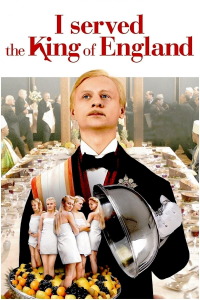
Review of I Served the King of England (2007) by Marko C — 27 Jan 2011
By Leon Conrad for remotegoat on 06/05/08.
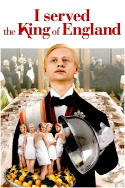
Jan Díte is a man who's set apart from others. What sets him apart is his height - he's short. He's also ambitious. Jan Díte wants to become rich. He starts out selling food to passengers at train stations. While honing his skill as a con artist, he becomes fascinated by observing people's attitudes to money. He cultivates a collector's mentality aligned with a talent for sniffing out opportunities. He works in a pub, then as a hotel waiter, acquiring bank notes, knowledge and experience by dint of his carefully honed voyeuristic talent along the way. Against the background of the German occupation of Prague, he falls in love with Liza, a Sudeten German. After a stint at the front, Liza returns with a valuable collection of stamps left behind as a result of the holocaust. After her accidental death, Jan sells the collection and invests in his own hotel. He ends up being sentenced to 15 years in jail, one for each of the millions he amassed. Everything he's built up is sequestrated by the Communist regime. He serves out most of his sentence in the company of fellow millionaires, a fellowship from which he is ultimately excluded. A few months short of his official release date, Jan is freed as a result of an amnesty, and sent to live in a deserted ghost town near the German border. He restores an old pub, during the process of which he collects mirrors and memories, out of which Jiří Menzel's 2006 film adaptation of Bohumil Hrabal's tale "I Served The King of England" unfolds as a series of flashbacks and stories which he tells to a couple who become his neighbours for a while they are on a mission to source timber from the forest near the town.
Hrabal wrote the story in 1975. It took eight years for it to be published. When it eventually came out, it appeared as an exclusive publication for members of the Jazz Section of the Czech Musicians' Union, to whom Hrabal dedicated it. In the heavily-censored Soviet-occupied period of Czech history, Hrabal's style of writing and his endorsement of the playfulness of the jazz musician's approach was seen by the authorities as the last straw. It took four years, but the Section's leaders ended up being tried and incarcerated. It was only after the so-called Velvet Revolution, the literary-led movement which overthrew the communist regime, of which the playwright and writer Vaclav Havel was a leading figure, that they were eventually released.
The juxtaposition of the effects of ideological oppression and a sense of playfulness and play - of the Marxist Homo Faber as a counterpoise to Huizinga's Homo Ludens - spans and dominates the book, but is brought to life, and given a different dimension in Menzel's film. Although gambling doesn't feature, the play of beer in a glass, the roles people play, the playfulness of people at different periods in a hotel swimming pool, musicians playing, and playing with money all do. Play and playing are major themes in this film, which charts a trajectory of playfulness across a particularly intense period in Czech history, which spans Nazi occupation and communist rule.
Across this time period, people play out their lives. People move differently, depending on the period in which they live. Over time, posture changes; as do gait and voice use. It is rare to find a period film which portrays these differences accurately. It is a tribute to Menzel's flawless direction of his perfectly-cast actors that these differences are brought out with such exquisite effortlessness.
In this film, almost any theme becomes a segment in a DNA-like strand which connects to others. That connection branches out via wider references both within the film and beyond it. Light, glass, liquidity, solidity and absolute vs relative values are just five such themes. I could list others, but that would take away part of the fun for the viewer. It is this attention to detail and depth of metaphorical approach which provide much of the justification for the undeniable claim this film has to classic status. Whether you just watch it for the fun of watching it, or whether you watch it with an eye for detail; whether you watch it once or whether you watch it more than once; whether you have money in your pocket or whether you've spent your last coins to see it ... watch it. This film will creep inside your mind and play with you. Watch it.
This review of I Served the King of England (2007) was written by Marko C on 27 Jan 2011.
I Served the King of England has generally received very positive reviews.
Was this review helpful?