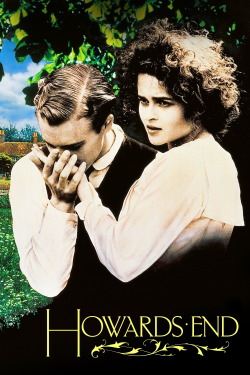
Review of Howards End (1992) by Grace C — 26 Sep 2009
Howards End was, at its core, an enchanting story revolving around the human condition, connection, and a lovely piece of property in the English countryside. While social mores and propriety were examined in the context of three separate socioeconomic classes, the larger themes at work were, in some ways, insidious and insightful. And while Howards End focused on several different characters revolving in concentric and sometimes overlapping circles around the Schlegel sisters, the underlying commentary was never lost or scattered. The story was satisfying and reached an acceptable and reasonable conclusion.
The reason why this film was nominated for so many Oscars was because, again, the production values of this picture were exquisite and superb. Howards End looked like something from a fairy tale; the art direction fueling the look of these turn-of-the-century English homes was painstakingly detailed, and the cinematographical shifts in light and hue of frame transformed Howards End into that magical something that made it different from the stuffy Wilcox homes or the cluttered London flat occupied by the Schlegel sisters. The film was as visually interesting as the story was engaging.
The movie was occasionally boring, though, only because the pacing was a bit inconsistent, particularly about the time that Henry Wilcox begins courting Margaret. The film failed to fully flush out Margaret's inner turmoil in navigating the opinions and emotions of those around her, and the film slowed up considerably when some of the events felt like a middle-of-the-road round of exposition to stage some of Margaret's subsequent reactions. All in all, though, there was an unmistakable examination of class that also seemed to be derisive of the aristocracy and mogul without being obvious or ham-fisted about it. The result was organic and relatable as well as contextual with respect to the fact that the film is set in early 20th century England - after all, it is a very rainy country.
The performances were also wonderful in this film. Every actor was engaging and interesting, with the possible exception of Nicola Duffett as Mrs. Bast. It was hard to feel sympathetic to her character, but, perhaps, that was the point, in order to draw a stronger viewer connection to Mr. Bast. Emma Thompson made Margaret so warm and multilayered, funny, wise, tragic, flawed, and interesting. Also, this character was able to experience many different emotions, and the suspension of disbelief was whole and complete thanks to Thompson's expertise at her craft. Her performance, in addition to the excellent production elements, made Howards End a magical and engaging movie.
This review of Howards End (1992) was written by Grace C on 26 Sep 2009.
Howards End has generally received very positive reviews.
Was this review helpful?