Review of Howards End (1992) by Edith N — 09 Jun 2009
Thanks to a little help from my friends, I have worked out the system for writing reviews. I still don't like it, but we do what we can, right? At any rate, I'm back in the swing of things, even if I can't do dual reviews anymore. Shame, really; I'm quite fond of them. I regret those missing few days--you all know how determined I've been to get reviews in every day, after all--but we do what we can with what we've been given, I suppose. Which, really, is not a bad summary for how the people in this movie think. (And, presumably, the book, which I've not read.) The fact that some of them are given more than others doesn't really matter to them. As Sondheim put it, "Some men have everything/ And some have none--/ That's by design." Of course, it's only the people who have everything that think that way, right?
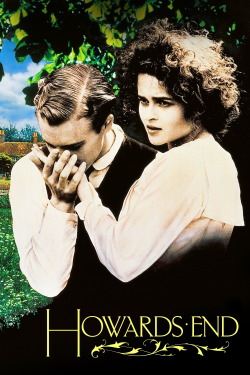
Helen Schlegel (Helena Bonham Carter) is Not At All Engaged to Paul Wilcox (Joseph Bennett). She thought she was, but he can't marry her; he hasn't money, and neither has she. It turns out, however, that her sister, Margaret "Meg" Schlegel (Emma Thompson) is friends with Paul's aunt, Ruth Wilcox (Vanessa Redgrave). Ruth is dying. She leaves a note--unsigned and in pencil--that her cottage, Howards End of the title, shall be left to Meg. However, her husband, Henry (Sir Anthony Hopkins), destroys it without telling anyone but his children. However, he becomes involved with the Schlegel family nonetheless, and ends up marrying Meg. On the other hand, Helen has gotten entangled with Leonard Bast (Samuel West) and his low-class wife, Jacky (Nicola Duffett). Things there don't really go well for any of them.
This is Merchant-Ivory working with E. M. Forster again. They're quite fond of his books--hardly anyone worked with them before he died, and they're mostly the domain of Merchant-Ivory (and their screenwriter, Ruth Prawer Jhabvala) now. Now, I've never read any Forster, and while I've seen at least one of the other movies, it was a long time ago and I don't remember it very well. However, it seems obvious to me that Forster liked playing with society, its expectations, and how people actually fit into them. The reason Bast marries the vulgar, drunken Jacky is that he promised to. Frankly, it ruins him. On the other hand, Henry just assumes that, in leaving Howards End to Meg, Ruth could not have been in her right mind. It is the poorer characters who are more accepting. The younger Wilcoxes are stunning in their obnoxiousness. Even the Schlegel boy, Tibby (Adrian Ross Magenty), seems intelligent and thoughtful, though he's also rather distant from the world around him.
This is, of course, a lush production. Fabulous costumes--even Jacky's clothes are shown in all their gaudy detail, and the actress herself plays the blowsy, earthy character quite well. (I do keep focusing on Jacky, but she's so out-of-place, and the story would be very different if she weren't there. She also shows no interest in learning, not even the sort of "well, that's men's business" that Dolly (?) Wilcox (Susie Lindeman, if I've got the right girl) has.) The sets essentially aren't; these are real places. The acting--well. Two of the main characters are performed by Oscar winners--Thompson for this very role--and the third is an Oscar nominee, and I won't be surprised if she wins one of these days. Vanessa Redgrave, in her minor role, is another Oscar winner--and an Oscar nominee for this. (Wasn't she the one with the "Zionist hoodlums" speech?) It seems, from what I know of them, that this quality is a hallmark of a Merchant-Ivory film.
Of course, it may not be your thing. Period pieces don't work for everyone. Nor does this sort of society drama. And the society these people are living in is [i]very[/i] important to the story. How different things would have been could Paul have just taken Helen off to Nigeria with him while he went to earn his living! Oh, it would have been an awfully short movie, to be sure. But it is, after all, sparked by the fact that Nigeria was no place for a white woman. This despite the fact that lower class white women were probably taken there by their husbands all the time. It is upper class manners that enforce the roles all these people will play, even though the Schlegels aren't upper class. They still strive to appear so.
This review of Howards End (1992) was written by Edith N on 09 Jun 2009.
Howards End has generally received very positive reviews.
Was this review helpful?