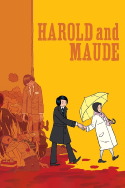
Review of Harold and Maude (1971) by Steve S — 11 Dec 2014
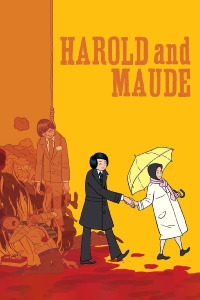
Harold and Maude (1971) is a film you will either site for changing your life, or you will go on for hours about how awful it was. There is seldom an in between. This is a film that is either inspiring or depressing, all depending completely on your own personal interpretation. Between the vague symbolism and the dramatic shifts between death imagery and life imagery, many are left unsure what to think. One thing is for sure, however: after watching Harold and Maude, you will be left shocked, and your overall opinion of this film will not be a quiet one.
Bud Cort plays the lanky, raven-haired, deep-voiced and baby-faced Harold Chasen. Discontented with his wealthy lifestyle, by the beginning of the film, Harold has committed suicide 15 times -- but that's just a "rough estimate." "And were they all for your mother's uh, benefit?" Harold's shrink asks. The relationship between Harold and his mother is one that has been covered in fake blood and silicone limbs. The opening sequence of the film is that of Harold swinging from a noose, with his apathetic mother talking on the phone in front of him. This type of scenario is not uncommon, throughout this story she is commonly seen turning up.
Her nose at, or just blissfully ignoring, Harold's staged suicides.
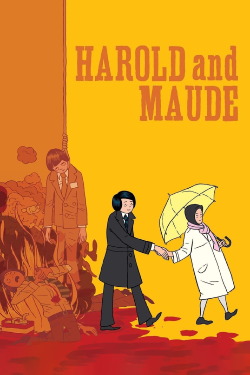
When asked what he does for fun, Harold answers truthfully, "I go to funerals." It is at one of these funerals that he meets a braid-wearing, free spirited seventy-nine year old woman named Dame Marjorie Charden (but you can call her Maude). Harold's first encounter with this strange old woman is brief, but soon she approaches him and offers him licorice. Their friendship only strengthens from there. He visits Maude's house repeatedly throughout the film, gazing at self portraits and drinking oat straw tea. Their relationship becomes much more than just friendship, however, to the dismay of Harold's family.
A common criticism of Maude's character (played by the lovable and sassy Ruth Gordon) is that she is a "manic pixie dream girl" (a woman who enters a film for the sole purpose of benefitting the male character). While this is ultimately true, I don't believe the concept of Maude's character to be quite that shallow. Maude is a meaningful and thought provoking character. A close look at her character would tell the viewer that she has been controlled by the possibility of death her whole life, and now wants to live life to the fullest. "Everyone has the right to make an ass out of themselves sometimes. You can't let the world judge you too much!" she jokes in one scene. Maude is certainly no side character, and to write her off as such, would be to miss the point of the film completely.
This film is exceptionally cast. The portrayal of Harold's character is absolutely spot-on, and I genuinely believe that not a single other person in this world could have done it better. Cort delivers every witty punch line with a dead straight face and a signature deep monotonous voice. Even when breaking the fourth wall, it doesn't at all come across as cheesy or unnecessary. This isn't at all like his previous film Brewster McCloud, where his character seems void of a personality and any depth whatsoever. Cort has never played a character better suited for his acting skill! By the end of Harold and Maude, you will begin to believe that he truly is Harold Chasen.
My own personal favorite aspect of the movie is the symbolism, often completely missed by viewers. The symbolism can completely change the meaning of the film from a dark comedy about a strange relationship, to a film about existentialism and living life to the fullest. Each moment in the movie is a necessary one, and every last detail has been clearly thought out. Everything from the color of the umbrellas at a funeral, to the flowers in the cemetery, to a seemingly random marching band, means something incredibly deep. Be careful not to blink -- everything in this film is some form of foreshadowing. Expect to need to watch it a few times.
One scene in particular is rich with symbolism and in many ways, summarizes the entire movie. Both Maude and Harold are sitting amongst a field of flowers near a cemetery (live versus death imagery). Maude tells Harold that she would like to be a sunflower. "They're so tall and simple. What flower would you like to be, Harold?" she asks. Harold replies that he would like to be a daisy because they're supposedly all the same. Maude seems concerned with his reply. "Oh but they're not [all the same]! See, some are taller, some are fatter. Some go to the left, some to the right. Some are even missing some petals! All kind of observable differences. You see, I feel much of the world's sorrow comes from people who are this, but allow themselves to be treated as that!" Maude says. This scene speaks to me on many levels, and never ceases to inspire me endlessly.
I am not the only one who has been inspired by Harold and Maude. My first experience with this film was through a 'History of the Motion Picture' class in high school. The teacher of this class introduced the film as his "all-time favorite piece of cinema" and continued to tell us about how this film alone inspired him to get up and leave for New Zealand, and hitch hike for months. This film is a life-changer; no exaggeration necessary.
Unfortunately this film is seldom shown in theaters. Even less often are DVDs sold in stores. In order to purchase or rent this film, you must seek online sources. However, undoubtedly, Harold and Maude is worth every penny you will pay, and the time you will wait for shipping and handling.
From the exceptional and thought provoking symbolism, to the unexpected plot, and the perfect cast, this movie is absolutely the best film I have seen. Harold and Maude means so much to so many people around the world. I believe the word "perfect" to be a very strong word, but I am confident that Harold and Maude is truly a piece of perfect cinema. If it doesn't haunt the back of your mind for weeks, or completely change your life, you might just need to watch it again... and again, and again.
This review of Harold and Maude (1971) was written by Steve S on 11 Dec 2014.
Harold and Maude has generally received very positive reviews.
Was this review helpful?