Review of Harlan County U.S.A. (1977) by Edith N — 21 Apr 2009
The horrible thing is that the things the strikers are fighting for in this movie include things that they are shown to be fighting for in [i]The Molly Malones[/i], set in the previous century, and things that they are still fighting for today. Coal mining is, and continues to be, one of the most dangerous jobs in the world, and many safety measures that could be taken are not, reliably. Oh, mining of any kind is just going to be dangerous, and there's no real avoiding that. There is always and will always be the chance that the Earth will not be able to keep the tunnels up anymore. Bracing the tunnels helps that. Modern bracing helps more than the older variety did. But Earth shifts. On the other hand, there are other precautions not taken, claims that the health effects of coal dust in the lungs are not actually what they are said to be.
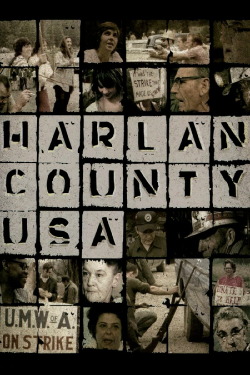
Barbara Kopple originally went to Harlan County, Kentucky, to document an internal power struggle within the United Mine Workers' Association. However, as 180 miners went on strike, it became just a small aspect of a larger story. The union, it seems, was less than concerned with the workers' plight. The coal industry was setting record profits, but the miners' salaries increased less quickly than did the cost of living. They lived in company towns without so much as running water. The strike lasted about a year, including a picket in front of the New York Stock Exchange in the hopes of attracting more national attention to the issues. Probably the movie, which received a Best Documentary Feature Oscar, did more. In the end, of course, it was the failure of a larger national contract that may have helped them even more than that.
The fact is, unions do not always have their members' best interests at heart. Some of them are corrupt. Several union officials here are shown to be firmly in the pockets of the various energy companies, most notably the Duke Power Comapny shown here. On the other hand, these are men who clearly need [i]someone[/i] to speak for them, an awareness of their plight given to those who can lay pressure in the correct quarters. A properly constructed union would help them with that. Over the years, many great benefits have been gathered by unions, and it is certainly true that men working alone could not have gotten the benefits granted to labourers over the last century and a half or so.
Kopple lets the miners speak for themselves. It is their words, their music, their faces that tell the story. And, over the course of that year, both sides seem to almost forget that the camera is there in the first place. Weapons once hidden now become brandished before the camera without thought of consequences. The raw emotion is unveiled. In the film's most famous moment, Florence Reece stands up at a union meeting and sings her most famous song, dating back to the days of "Bloody Harlan," "Which Side Are You On?" The days of Bloody Harlan have (mostly) moved on, but the sense of choosing sides has not ended and likely will not end any time soon. A woman bathing her child in a washtub assures the child that the day will come when they live in a real house with a real bathtub and real hot water. That is what they are fighting for, and the coal company claims they will have it--by and by.
It is hard to be objective in such a story. The mind does flash back to that woman and her child. That old woman singing a song she'd sung many times before. The sound of bullets in the night. Another old woman collapsing at her son's grave. And those fantastic figures, the stunning profit compared to the stunning poverty in which the workers live. And the uselessness, the complicity, of the union. All the pain, all the suffering, all the foolishness. They say in the movie that what they do, they do for their children and grandchildren. I have heard tell that the situation in Harlan County has gone downhill since the film was made, but I suggest that the film shows a forty-year pattern of misery to the population. I cannot imagine it has gotten much better.
This review of Harlan County U.S.A. (1977) was written by Edith N on 21 Apr 2009.
Harlan County U.S.A. has generally received very positive reviews.
Was this review helpful?