Review of Harlan County U.S.A. (1977) by Guess W — 29 Oct 2013
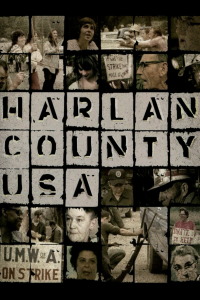
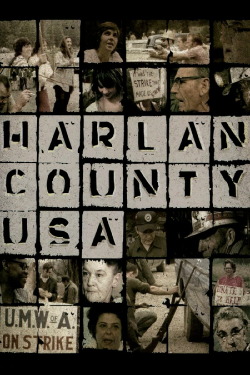
The United States of America is a nation known for its freedoms and equalities for all its citizens. However, inevitably, there exist certain regions inside this great nation that are far from the public eye, where people's freedoms and equalities are taken away. Documentary film Harlan Country, USA records the "Brookside Strike" in 1973, a long and rough struggle of the miners in the Brookside mine against the mine-operating company to improve their pathetic living conditions and dangerous working conditions. While showing the struggle, more importantly, the film shows its audiences of the cruel reality that there are people among the working class in the US who are under the economic oppression of the capitalist.
As the miners are going on strike, the mine-owner company, Duke Power Company, hires strike breakers, who are referred to as "scabs" by the miners, to keep the mine operating. What's more, the mine operators also hire a group of "gun thugs" to clear out the area where the strikers are picketing in order to ensure that the strike breakers can get to work. Not surprisingly, conflicts break out between the strikers and the "gun thugs", with the "company-hired strikebreakers armed with guns and clubs beating and shooting people on the picket lines" (46), as described by Gary Crowdus in his essay. Along with the conflicts, the film also contains archival footages about the past disasters of the mines, the black lung disease which miners suffered from, as well as current footages disclosing the appalling living conditions the miners' families are offered. As the conflicts exasperate, a young miner who is associated with the picketing is killed by the shooting from one of the "gun thugs".
In this film, cinematography and mise-en-scene are utilized by the filmmaker to remind the viewers that economic oppressions indeed exist in the US, where the powerful companies offer their workers harsh living conditions and precarious working conditions and moreover, employ such means as violence to suppress the workers from demanding what they deserve.
The miners' poor living conditions are revealed in the film. In the scene starting from 19:08, a miner's wife is giving her daughter a bath in a wood tub on a counter. The tub is so small that the little girl claims, "I can't get my foot in". Apparently, this family does not have running water in their house. This particular selection of mise-en-scene, the simple and crude wood tub, as the means with which the miners take baths, arouses attention to the housing the miner families have. Given that the setting of the film is in the 1970s, it appears to be absurd that those poor families are living without running water in their house. This scene, in an ironic contrast with the scene in which the representative of the mine-operating company claims, "there just can't be any question that the health and safety of our employees must be given first priority", highlights the company's greedy desire for profit and its cruel treatments for miners as a method of maximizing profit.
Furthermore, the miners' working conditions appear to be precarious and health-threatening. One particular negative aspect of the working conditions, the black lung disease countless miners have, is illustrated in the scene starting at 36:10 of the film. When interviewed about black lung disease, a doctor says, "it's preventable ... other countries have done it". However, also shown in the scene are many helpless coal miners tormented by this disease, which point the saddening fact that the coal mining companies have not done what can be done to protect the health of their miners. What's more infuriating is the speech given by an attorney of a mine-operating company which attempts to deny the company's responsibility of the miners having black lung disease due to unsafe working environment. This speech, in the form of diegetic sound of the film, contrasts with the statement made by the doctor to further reveal the greediness and oppressing nature of the mine-operating companies.
Given the unjust conditions the miners have, naturally, they go on strike to demand better treatment; however, the miners' effort of picketing is met by violence from gun thugs hired by the Duke Power Company. The scene starting at 54:13 of film shows an outstanding conflict between the two groups. In order to prevent the strike breakers from getting to work, the miners blocked the road through which the strikebreakers have to pass to get to the mine. When the gun thugs, led by a squinty-eyed man called Basil Collins, show up to clear the way, they drive through the blocked road forcibly in their big trucks, ignoring the miners standing in front of their vehicles. In this particular scene, the camera tracks the truck and keeps it a prominent element on the screen. When the truck speeds up to get pass the "men-wall" of miners, the camera also tracks with a higher speed to capture the motion. This resonance in movement, the screen and the object within, intensifies the motion and enable the viewers to sense the forcible violence in a greater depth.
In the subsequent scene, the gun thugs, led by Basil, walk towards the miners brandishing their weapons. In particular, Basil had his right hand around his right pocket the whole time, holding the pistol inside his pocket. The camera first tracks Basil when he is walking, then gives his right hand and the grip of his pistol an extreme close up. This manner of filming, intuitively, emphasizes the method through which the gun thugs threaten the miners and thereby reinforces the idea that these miners are under oppression of the mine operators. Although no violence breaks out blatantly in this scene, the presence of the pistol clearly indicates that the mine-operating company is choosing violence in response to the miners' appeals.
In logical orders, the film reveals the disturbing living and working conditions the miners have, the irresponsibleness of the mine-operating company, the picketing of the miners as a means of demanding treatment, and the violent suppression by which the company employs in response to the strike. This sequence, as interpreted above, is attempting to address the astonishing reality of the existence of economic oppressions exerted by the capitalists on the working class in the US. By doing so, the film also demands attentions and awareness for other fellow Americans who may be experiencing similar oppressions and calls for actions from the society to give them a hand.
In summary, this film is extremely persuasive in that it remains relatively objective despite its political nature; what's more, "it has as much dramatic power and impact of a fiction film" (Crowdus 46) in that it emotionally connects the viewers to the miseries of the miners and the cruelty of the mine-operating company. I personally recommend this documentary film for its great success in integrating documentary elements and dramatic aspects.
Work Cited.
Crowdus, Gary. "Harlan County, U.S.A.". Cineaste (ARCHIVE); 1977.
Harlan County, U.S.A. Dir. Barbara Kopple. First Run Features, 1976. Film.
This review of Harlan County U.S.A. (1977) was written by Guess W on 29 Oct 2013.
Harlan County U.S.A. has generally received very positive reviews.
Was this review helpful?