Review of Gray Matter (2004) by Andrew J — 19 Jan 2009
As I've said before, it frustrates me to no end that people aren't better educated about the Holocaust. I have never said that we shouldn't remember the six million Jews who died. I [i]would[/i] never say that, because I'm neither callous nor an idiot. What I'm saying is that people should know that it wasn't just Jews. I admit that it's personal for me--I had family in that area, and they're probably dead now. Well, they probably would be anyway, but you know. But forced sterilization began in 1934, and the wholesale killing of the mentally and physically handicapped began in 1939. More than 200,000 mentally ill people are estimated to have been killed, with at least that many physicall disabled people sharing their fate--and possibly as many as twice that.
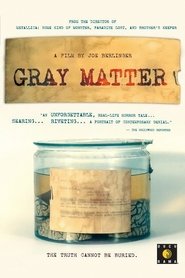
On 28 April, 2002, the brains of some 700 children euthanized at Am Spiegelgrund, an institution in Vienna, were finally buried. The children were killed during World War II. The doctor responsible for the program, Dr. Heinrich Gross, had been writing papers based on their preserved tissue since not long after the war. Finally, the Austrian government allowed the burial of what was left of those 700 children--the film never makes clear what happened to their bodies, though I have some ideas. American filmmaker Joe Berlinger was one of the journalists who went to observe. While he was in Austria, he decided to attempt to find and interview Dr. Gross.
Someone in the movie observes that the Austrians have always claimed to be the victims of Nazism, but there was a fair amount of collaboration. Certainly Dr. Gross seemed to have had no problem going along with the sterilization program. He is proven to have killed nine children himself; in his trial just after the war, he was released on a technicality. In his trial just a few years ago (he died in 2005), he was pretty much declared mentally incompetent himself, which does have a certain amount of grim humour to it. The remaining survivors filed a class action lawsuit against him, but I'm unable to find any details on the outcome. It's possible, even probable, that he died before there was one, all things considered.
I admire Joe Berlinger's determination, here. For one thing, he did his level best to interview people himself--in German, which he clearly doesn't speak. In fact, he doesn't seem to have brought an interpreter along with him. He certainly knows how to say "Do you know if Dr. Gross lives here?" He's fortunate in that a lot of the people he encounters speak English, but I admire him for making the attempt--and making a film that most Americans simply don't care about. Probably most people worldwide, I suspect. I mean, even I who study gentiles in the Holocaust on a regular basis had never heard of Am Spiegelgrund.
I wonder what kind of follow-up Berlinger could make now that Gross is dead. The one person with whom he managed an extensive interview, a doctor who worked in the "Brain Room," was fired. Many other people said they would only talk to him when Gross was dead, of those who said they'd talk to him at all. This documentary is only an hour long, but it raises a lot of questions and makes a lot of points. Why was Dr. Gross able to get away with his crimes? There was enough evidence to put him away, and certainly the specimens should not have been available for him to study for fifty years. Why was he allowed to present medical evidence at so many trials that it would have been impossible for him to have properly examined all the patients? Why, in fact, was his medical license not taken away in the first place? It was only because he was captured by the Soviets that he avoided the Nuremberg trials; I wish, and I'm not alone here, that things had been different.
This review of Gray Matter (2004) was written by Andrew J on 19 Jan 2009.
Gray Matter has generally received positive reviews.
Was this review helpful?