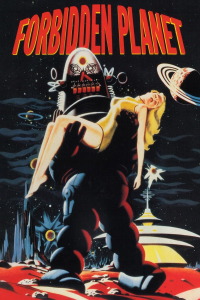
Review of Forbidden Planet (1956) by Joshua H — 02 May 2013
5/1/13.
Director: Fred M. Wilcox.
Finding The Tempest in Forbidden Planet.
Fred M. Wilcox is well known for basing his 1956 science fiction classic Forbidden Planet off of William Shakespeare's beloved The Tempest. In actuality, Forbidden Planet is an adaptation of the magical play, with some minor changes, which service the story, and the time in which the film was made.
Before we examine the characters in the film and play, we must first examine some of the film's setting (and the play's). Like the classic sci-fi that it is, Forbidden Planet is tremendous at sending it's message - as a great film should, it shows us the struggles in it's narrative, rather than bashing us over the head with annoying narration every time something is meant to be implied. Forbidden Planet plays as a warning of the power of technology, and a warning of the human subconscious, suggesting that balance between the two is where peace lies. The Tempest on the other hand, is a play, and it should be noted that film and the stage send information in different ways; while it is effective to show us information in film, more often in a play speaking vital clues and details is essential, being that not everyone in the audience has the best view of the stage.
The Tempest takes place on an island, belonging to Prospero. In the film, the island has been changed into a large forbidden planet (hence the title); the play's ship is now a space ship. Forbidden Planet introduces us to technology from the very beginning of the film. Technology here, unlike the majority of science fiction, isn't stressed as being good or bad - and the only thing in Shakespeare's play I can relate it to is magic. If an audience in Shakespeare's day viewed Forbidden Planet, they would interpret Robby, and the wonderfully dated animation sequence of the Monster of Morbius' Id, as magic.
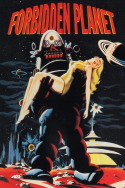
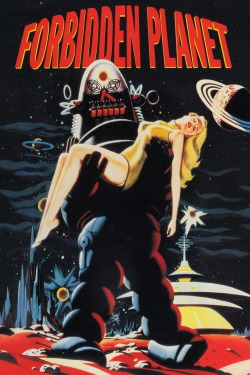
Speaking of magic, the iconic star of the film, Robby the Robot, is important not just as the film's Ariel, but important to the science fiction genre in general, because he is credited as being the first fully realized character that was not a human - he is a robot, and at that point in the 50's, robots were usually only monsters or some puppet for a human character to use. But not Robby; he is a character with humor, and emotion, that plays a significant role in the plot. This says a lot about artificial intelligence, almost encouraging it if it were done correctly. Robby is the perfect being created by humans - he does not have some plot to destroy his maker, and although he understands the limits of his "brain", he is perfectly happy living in those circumstances. Nothing makes Robby happier than serving his master, and he understands his place in the universe. In the play, Prospero claims Ariel as "thou, which art but air..." which reflects the first appearance of Robby, through a cloud of smoke zipping through the desert to reach the space crew we've just met.
Of these men, Commander John J. Adams is your usual hero archetype; Leslie Nielson is wonderful in the role, mustering up the perfect blend of charm and charisma, and always someone to trust when we enter the mysterious planet. What comes through most is his humor, and unflinching ability to swoon Altaira Morbius. It's important that from the opening scene of the film that we connect with Nielson, as so much of the plot in the first act in introducing us the strange new characters, ideas, and an entire planet. There isn't much time in the rest of the story to develop him. Like in The Tempest, where the reader is introduced to the island by way of discovering it alongside a crew at sea, we connect with the space crew from their first few moments of dialogue. Forbidden Planet is not without its dashing leading men, who as the film progresses erode until its just Nielson. Aside from Airplane! This is easily my favorite performance of his.
Next in line is Nielson's love interest, Altaira Morbius, who certainly is charming but if I had to pick a weaker part of the cast, it would be her. Anne Francis is not bad in the role per say, but she is a little too unassuming at times; her big doe-eyes are cute at first, and definitely get the message across that I am supposed to feel sympathetic to her for not understanding the world as her father does, but this part of her drags on a bit. By the time the third act rolls around, I asked myself "does she understand anything?". And no, she's not stupid, but this part of the film does age it a bit, and reminds you to be in a 1950's mindset. Altaira is a mirror of Miranda, who are both pure, young women who have distinct links with nature. If this film ever gets remade, (which talks of that happening have been going on for a good decade now) Altaira's character would be the one with the most need of an update. One could argue that as in Shakespeare's story, her innocence is very welcome, which I agree it is. She lets the audience in, and serves as the one to cling on to if you're not fully understanding everything going on. It just felt weird coming from a piece based off one of Shakespeare's plays, which are known to have unusually strong female characters.
Altaira's father, Dr. Morbius, serves as the film's Prospero. The only major difference is that in the play, Prospero is aware of his power - he knows that he is magical, and that his island belongs to him. However in the film, Morbius is unaware of the power he possesses; this, ultimately is his downfall, and causes him to fail in the third act. Prospero is helpful with his magic; Morbius is anything but helpful with his scientific "genius" - except for his creation Robby, who is plenty of help when defense is needed. Morbius is a dual personality; he most often acts on a rational plane, seeking the most logical conclusions to any questions brought forward. However it is his own Monster of the Id that is a symbol for his instincts. Morbius is great here, tragic like the character he is based on - his presence on screen is immediately felt, filling the role of the "scientist" similar to the likes of Dr. Frankenstein or Rotwang in Metropolis. Like Dr. Frankenstien, he is a tragic man, who longs for a great goal but fails in the process. His Freudian Monster of the Id (which was marvelously done and rather entertaining I might add) is agreeably seen as Caliban, the monster-man on Prospero's island; the Cook is Stephano.
Forbidden Planet was originally released (as previously stated) in 1956, when the United States was well into the atomic age and the Cold War. Japan's allegory of nuclear devastation, Gojira, had premiered a year earlier, and the world was stuck with the notion of nuclear supremacy being more devastating than helpful. Unlike Prospero, who used his magic for self-gain, the science of Forbidden Planet is meant to further all of mankind. Morbius knows that he is not the ultimate power, and the film suggests a warning to the world, reminding us the "...we are not God..." in it's final scene.
Spiritually, the film hasn't aged despite it's very 50's mindset. Lines claiming God as the ultimate power are scattered throughout, and while I wouldn't say this is a Christian film, it certainly has some ideas that I as a Christian could latch onto, giving the film a little bit more to chew on. First of all, the film is about a man who lives in ultimate power over a planet, who has to learn his dominion over said planet is not his greatest accomplishment - his daughter is. Secondly, the film's characters do not gain any sort of power, and it teaches that having power is not a guaranteed perfect life - in fact, the film suggests a more humble attitude to the things beyond our control is more applicable. "Let everyone be subject to the governing authorities, for there is no authority except that which God has established. The authorities that exist have been established by God." - Romans 13:1, as Paul ascribes. This is something Christianity teaches, as Christ often spoke of being loving, and caring for people we do not know or understand. Science Fiction in general is a genre that begs for answers, and understanding; all of these things are what Christians hunger for in our daily walks with Christ. The genre often asks what our purpose is here on Earth, and God grants us knowledge of that purpose by way of relationship with Him.
Forbidden Planet and The Tempest are both marvels to behold in their mediums. They both have stood the test of time, and serve for different ways to hear of the same message. If you can't stand Shakespeare's diction, perhaps Forbidden Planet is for you. If you have a hard time sitting through older films with slower paces and dated effects, the maybe The Tempest will appease you, allowing you to read at your own pace, and to use your imagination. They work well together and separately, warning of too much power and reminding us to be thankful for what we've been given. Both are excellent, Forbidden Planet in particular is a great translation of the original play and serves as a perfect example of the notion that there are no new ideas - everything in film and science fiction has been done before in some way. It's not about creating new ideas; instead it is about using something old in a fresh, intriguing way.
This review of Forbidden Planet (1956) was written by Joshua H on 02 May 2013.
Forbidden Planet has generally received very positive reviews.
Was this review helpful?