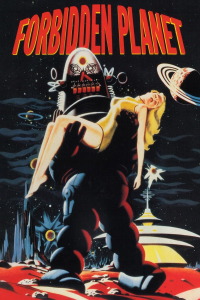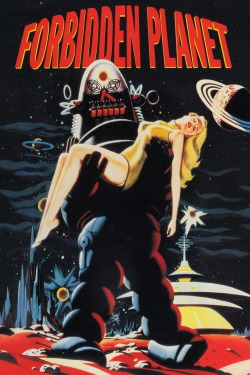
Review of Forbidden Planet (1956) by Everett J — 16 Aug 2008
Forbidden Planet.
Directed by Fred M. Wilcox.
Written by Cyril Hume.
Based on story by Irving Block and Allen Adler.
Starring Leslie Nielsen, Anne Francis, Walter Pidgeon, Richard Anderson, Warren Stevens, Jack Kelly, Earl Holliman.
More than 50 years beyond its initial run, The Forbidden Planet remains a benchmark in Science Fiction cinema and an exquisitely crafted and tense dramatic film with seminal music and superb set designs and special effects.
This is the kind of film that begs to be studied by film students worldwide. The look of it is sublime and exceedingly realistic; it creates a new, distinct world of futuristic weaponry and technological wonders with every frame. It?s a symphony of cataclysm, a divine reckoning that softly reflects the terrors inherent in the becalmed minds of so-called civilized man. There is truth here and a beguiling array of seismic permanence that reflects the myriad complications imbedded in consciousness. The film remains a totemic exploration of fear and tyranny, a grave reminder of mankind?s hubristic tendencies and the mechanisms that fuel the pursuance of scientific inquiry to their ultimate ends.
The story involves deep space exploration of the planet Altair IV, a planet once inhabited by the mighty Krell, a civilization millions of years in advance of our own. Spontaneously and without warning the entire civilization died out 200,000 years ago and the film explores the nature of their sudden demise. There are only two survivors on Altair, the philologist Dr. Edvard Morbius (Pidgeon) and his daughter Altaira (Francis). Morbius has received a brain boost from one of the Krell?s devices called the Plastic Educator and has built a scientific wonderland including Robby the Robot, a multi-functional entity who speaks all the world?s languages, possesses immeasurable strength, cooks breakfast and even makes Altaira?s dresses. When the humans land three of the key officers?Commander John J. Adams (Nielsen), Lieutenant ?Doc? Ostrow (Stevens) and Lieutenant Jerry Farman (Kelly)-- are transported to Morbius?s palatial home by Robby where they are aghast at the level of sophistication mustered by Morbius as well as the Krell facilities.
The mission is to discover what happened with a colonizing effort twenty years back that mysterious disappeared. The pall of their demise hangs over the film as it is apparent that the officers aboard this new mission are not aware of what they are in for. Every movement, every gesture can potentially trigger the same force that eradicated their compatriots in the blink of an eye. It?s harrowing and dark and rife with an indescribable tension that the film maintains effortlessly throughout. There are moments of sheer terror that are the result of a purely effective storytelling that carries the film and accentuates the physical reality conveyed by the film.
Morbius has been altered and has reached a level of scientific capability that dwarfs those exhibited by human scientists. He has created a futuristic home that causes one to wonder when science fact is going to fully catch up on the domestic front. The instruments of the Krell are momentous and deftly poetic. The symmetry of their design give them a heightened beauty that comes through a brilliant use of set design and an appreciation of the basic premises of the fine arts. This film is a fine example of the use of style and form to express psychological states that permeate the film with decision and intensity. The scenes with the Krell machinery are cold and inhuman. There is a feeling of isolation in their elegant structures; each piece of equipment conjures up images of Futurist landscapes populated by Totalitarian dreams. There is much fear imbedded in this mesmeric technology that exists on a plane so far beyond human capacity that it simply beggars belief.
The music in this film is yet another component that is implemented with great precision and a style that war far ahead of its time. It?s the first film with an exclusively electronic soundtrack and the bleeps and whirls prove to add another level of intensity to the film. The result is an exhilarating experience that supercedes most other soundtracks in terms of poignancy and organic urgency. Considering that the electronic music featured in this film was at that time utterly novel in terms of soundtracks, it comes off as multi-dimensional and wholly demonstrative. It?s a voice that is added to the dialog and propels the film forward, sharp and angry, caustically bringing a particular mood that is cooly maintained.
Eroticism is a fundamental aspect of this film. Altaira is a young, nubile female who as the film opens has lived her entire life isolated from men. She is presented as coquettish albeit entirely naive of the machinations of intimacy and sex. Straight away it is apparent that the film wants to focus its attention on her comely form. Her outfits are revealing and she carries herself in a playful manner that is decidedly erotic but not necessarily sexual. Indeed, she is clueless about human sexuality and is initially not impressed with the act of kissing. She states that it doesn?t stimulate her but is eager to try again. Eventually she falls for Captain Adams and the two of them forge a tight little bond. Still, Altaira is fundamentally a girl-woman who ostensibly is to be taught everything Adams has stored regarding human sexuality and will be subservient to his human will.
The Krells are portrayed as a hyper-advanced race of beings who managed to rid themselves of their corporeal forms. Strictly, they became pure consciousness that unfortunately were unable to divest themselves of their primitive subconscious desires and fears which they projected outwardly to the grave detriment of their race. This film employs Freudian psychology to help explain the role of the unconscious in this destruction; it is due to the wholly destructive manifestations of the id.
The performances in this film are quite sufficient for this genre. Of particular note is the work by Anne Francis who demonstrates a cool authority with her line readings that are forceful and precise. She adds a distinct quality to this film that comes through her gestures and posture. Altaira carries herself like a princess and in a very real sense she has been raised as one. Indeed, she is truly regal and untainted by any fears regarding her sexuality. She is essentially Eve who is wholly innocent of the ways of the world and who has been isolated from anything potentially corruptive. Walter Pidgeon is remarkably vital and present in this film. He is a force of nature whose character adds a threat to the narrative. Morbius demonstrates the wildly ambitious potentialities of science and all human endeavor. He?s coldly efficient in both his demeanor and his obvious capacity for creation. Leslie Nielsen affects an unfamiliar seriousness in his role as the primary representative of Earth. His character comes to Altair bearing all of the responsibilities of heroism, audacity and vision. He becomes Altaira?s gallant rescuer, every man writ large in an environment where human ingenuity and emotion is exceedingly limited. Nielsen is sturdy, unflappable and emotionally impenetrable in this role.
Overall, this film sets a high standard for the Science Fiction genre. Artistically its a bona fide triumph of both style and austerity. It?s cold and terrifying in its implications about the nature of human inquiry and its limitations in finding answers to questions that perhaps we are not yet equipped to suffer their consequences. The mind is explored as a reposit for everything grand and terrible that has been instigated by human kind in its effort to reach the exalted realm of the gods. The symbol of the great machine as the ultimate inhuman creation capable of creating material objects out of mere thought resonates in our own time. With our reliance on our entertainment devices the next logical step would seem to be harnessing the mind to project in a similar fashion. But naturally, it?s science fiction still, isn?t it?
This review of Forbidden Planet (1956) was written by Everett J on 16 Aug 2008.
Forbidden Planet has generally received very positive reviews.
Was this review helpful?