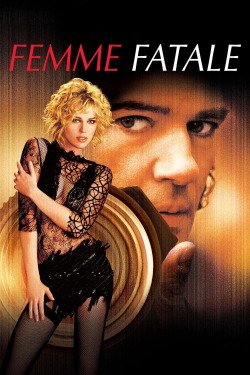
Review of Femme Fatale (2002) by Cassandra M — 16 Aug 2008
"Femme Fatale" is best understood as a game played by Brian De Palma and appreciated by knowing cineastes. It's not about story or characters, but about the construction and manipulation of art.
Antonio Banderas plays Nicolas Bardo, a photographer who has turned his back on photographing celebrities. He now spends his time living in an apartment, making huge composite images by arranging tiny photographs. The Bardo character, in many ways, is Brian De Palma. At war with Hollywood storytelling (which is fuelled by celebrity) De Palma takes these multiple images and weaves them into a tapestry until a final image is made. The point is that the final image is not reality. It is the artists recreation and completely false.
At the end of the film, Bardo completes his masterpiece by inserting a little white figure (of Laura) onto his wall. The figure doesn't belong there, Bardo simply chooses to put it there. Thematically, "Femme Fatale" ends on the same note. Noir fatalism is thwarted by a completely arbitrary, totally ILLOGICAL and cosmically IMPOSSIBLE moment of editing whereby De Palma redeems his hero and kills off her opponents.
Critics call this sequence implausible. But De Palma's point is that it doesn't have to be plausible. Bardo puts the white figure on his wall because he wants to. Similarly, De Palma ends the film as he does, because he wants to. He shows us Laura's depressing noir dream and then rescues her from it. He makes it clear that he is redeeming her and willing this positive ending into existence solely because he as an artist (noir God), has the power to do so.
This flips the usual noir logic. If Kubrick's "The Killing" highlights the deterministic law of the universe (Clay's plan crumbling to pieces all because of a random poodle), De Palma's "Femme Fatale" highlights the power of the artist, able to do recreate a universe entirely devoid of cosmic law.
This theme is also highlighted by the use of the name "Bardo", a Tibetan word meaning "intermediate state". A state between life and death. Over the course of the film, Bardo will be caught between life and death, as De Palma toys with killing him. Bardo's existence or artistic merit is down to an artist's mere whim.
Everything else about De Palma is present in Femme Fatale: the voyeur and his object, the representation inside the representation, the original and its fake copy, the doubled characters, key episodes built from multiple points of views, the elaborate camera work.
Watch as De Palma's camera continuously misleads our eyes, giving the hidden predominance over the shown, until we are forced to separate in our minds the real from its representation and to connect the different pieces into a "sense".
This technique comprises the film watching experience as a whole, and is what De Palma's films are essentially about, from Jack Terry's reconstruction of a truth with the aid of montage in "Blow Out", to Santoro's investigations of a crime from partial testimonies in "Snake Eyes".
This theme, the division between reality and image, has grown increasingly important for De Palma. His last five movies ("Redacted", "Dahlia", "Mission Impossible", "Snake Eyes," and "Mission to Mars,") were all concerned with how we see and watch movies. He is obsessed with reminding us that information is not the same thing as knowledge.
"Snake Eyes" opened with an unbroken tracking shot that laid out the plot. The rest of the movie was a demonstration of why everything we had seen in that sequence was a lie. The opening sequence of "Mission: Impossible" showed us Tom Cruise's crew of agents being picked off one by one. We had already seen each of those murders, though, in nearly subliminal blips during the movie's credit sequence (information without knowledge). "Black Dahlia" and "Redacted" similarly deal with a search for truth amongst an image bank of lies.
"Femme Fatale" begins with a long heist sequence. Throughout this sequence, allusions are made to "Snake Eyes" (eg- the literal "serpent camera" and the object of the heist, a snake shaped piece of gold), De Palma effectively saying: "I'm lying to you. The camera is a snake and not to be trusted." Note the film "Est - Ouest" showing as the heist goes on. Another stream-of-consciousness film with an unreliable narrator.
The rest of "Femme Fatale" takes a "dream within a film" approach, (foreshadowed in opening shot). De Palma sets the dream sequence up with careful details: the storm, the clock (Time: 3:33), the water running, Laura sinking. Signs that would eventually emerge all the way through, emphasising the surreal atmosphere of Laura's adventure.
From here on, logic will be put aside as De Palma's mise-en-scene develops into pure form. Everything is disconnected, dialogue makes no sense (at some points it's dubbed without even following the actors' lips), time jumps back and forth etc.
During the dream, Laura will embody different female archetypes, all traceable in film history and particularly in De Palma's films. She's Kim Novak in "Vertigo" and also Melanie Griffith's prostitute of "Body Double" and so on and so on.
The majority of De Palma's films have dream sequences. Even a "serious" film like 'Casualties of War' ends with a character waking up on a train, realising that the whole film was a nightmare. Why does De Palma feel the need to insert this? My guess is that he doesn't want his films to be seen as "real". They exist in a wholly metaphysical space.
As usual with a De Palma film, critics and audiences rejected Femme Fatale. But this is a brilliant film, it's only flaw being an unimaginatively shot (by De Palma standards) heist sequence.
This review of Femme Fatale (2002) was written by Cassandra M on 16 Aug 2008.
Femme Fatale has generally received mixed reviews.
Was this review helpful?