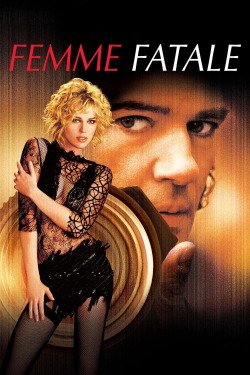
Review of Femme Fatale (2002) by Blake P — 05 Jul 2015
The older acclaimed filmmakers get, the harder it is to retain the excitement found in their earliest films. If you're Michael Bay, no problem - you were never respected to begin with. But if you're an auteur that blew the minds of audiences and critics alike for a generation, there's a good chance you'll slip up in your later years and get lost in the sands of time. It happened to Hitchcock, to Donen, to Wilder; and, if you want to talk about present day tragedies, I could passively mention Dario Argento and Brian De Palma. But we don't have to go there.
One doesn't want to slip up - but the more directors stick to their guns, the more their style seems to inevitably age. Wes Craven was meta and fresh come "A Nightmare on Elm Street" and "Scream" time, but these days, he's considered to be the guy that revamped the horror genre in the past, presently a living legend who just can't seem to relive his glory days. Francis Ford Coppola made the 1970s, but currently spends his time releasing little seen indies that only suggest a fall from grace.
But let's go back to Brian De Palma. The Alfred Hitchcock of the 1970s and '80s, billed as the Master of the Macabre, he refreshed tired thriller predictabilities using metallically lux photography and implausible plot twists to complement the tone, not the little-there realism of it all. "Sisters", "Dressed to Kill", "Blow Out", and "Body Double" are untouchable masterpieces in sheer filmmaking, even if some of his choices are questionable - his most famous movies, "Carrie", "Scarface", and "Mission: Impossible", are famous for a reason, but hardly capture the same cockily audacious sleaziness of its sexy counterparts.
But as time as gone on, De Palma's fondness of split-screens, laughable plot twists, and sunglassed blonde vixens with a like for cigarettes and sunglasses have gotten remarkably stale, most evidenced by 2012's awful "Passion". "Femme Fatale" sees him transitioning into that "old man" faze - though a lot of it doesn't work, a lot of it does, in ways as stimulating as earlier, fantastically realized moments in his filmography. There's a lot I could complain about (consider that De Palma decides to pull the rug completely out from under his plot right at the conclusion, leaving us dissatisfied and upset), but there is also a whole lot I could praise. While "Femme Fatale" is imperfect, it is often times electrifying, containing some of De Palma's most artistically brazen sequences.
The titular femme fatale is Laure Ash (Rebecca Romijn), a slinky thief who, in the introduction of the film, participates in a risky jewel heist at the 2001 Cannes Film Festival. But things get complicated, and, unfortunately for her fellow criminals, Laure outsmarts her accomplices and ends up with the goods. After the adventure, she realizes that living the life of a piece of scum isn't for her, and so, after thinking the film is going one way, we are jerked as it cuts seven years into the future. How she gets out of trouble I cannot reveal - let's just say that some people show up in the right place at the right time. When we find her in De Palma's 2008, she is the wife of a millionaire, her past coming back to haunt her at the wrong moment. But this isn't a case of a tainted woman wanting to forget about what made her tainted in the first place; it is the continuance of a manipulator's quest for power after a long hiatus of keeping devilish instincts hidden.
"Femme Fatale" gets more and more annoyingly incomprehensible as it goes along, but never does De Palma's style stop delighting us. Perhaps at the peak of his silky intuitions, he can pull off convoluted instances of slow motion cat-and-mouse games and voyeuristic split-screen snapshots because it feels so right. Tricky and exotic, "Femme Fatale" is the kind of film that flourishes the most when it's choosing style over substance - a shame that De Palma thinks that a final plot puzzle that ruins everything will actually enchant us.
But there's too much good here to write off. The entire opening might be the best of his career. (The camera zooms in on a grainy version of "Double Indemnity" on a French television set, the subtitles giving it an allure hardly seen before. As the lens pulls back and reveals a shapely woman laying on a white sheeted bed, wearing nothing but lacy blank underwear, a cigarette dangling from her mouth, her hair slicked back, passively watching, we are hypnotized; the rest of the scene, mostly without dialogue and mostly recorded in single takes, transitions into the robbery itself, which, in turn, is sensationally executed.) But after these initial scenes end, "Femme Fatale" strolls along without the tension it once had and the sexiness it once put into our laps. But it has its moments, with an endlessly provocative Romijn to tie it all together. De Palma is one of the great modern filmmakers, and although the film can sometimes be slight, you can hardly deny how effortlessly his boldness translates onto the screen.
This review of Femme Fatale (2002) was written by Blake P on 05 Jul 2015.
Femme Fatale has generally received mixed reviews.
Was this review helpful?