Review of Fear and Desire (1953) by Mike H — 26 Nov 2010
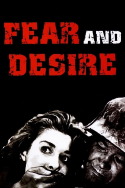
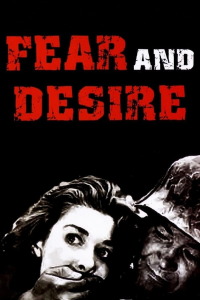
This is an unorthodox case for a first film. It is the first feature-length film directed by Stanley Kubrick, who in my opinion is one of cinema's quintessential auteurs, which he firmly resolved to withhold from the public not long after its release. I already knew this was one of his earliest films from a glance at his filmography, although my interest grew more passionate when I read about how he viewed it. The film had been shot in a forest in California on $10,000 with a miniscule cast and crew and dubbed for the same amount. In interviews, he regarded it as an amateur project from which he continued to improve his technique. And, though he doesn't explicitly say it, it should not be seen since he's made better films anway.
Watching this film, which could only be done through the good ol' Web, one can see Kubrick struggling to make art with his resources. It is a movie about war, but in the simple sense where there is a deserted forest, two opposing sets of soldiers (there's an oblique twist here), a trapped villager, and the goal of getting out alive. It's well photographed for an amateur dramatic piccture in the 50s. Kubrick, who shot the film himself, already has the skill of forming tension in the scenes of navigating the shady landscapes. The lighting is deftly utilized to intensify the unnerving closeups highlighitng the emotions building through the film. There are introspective monologues mixed into the somewhat Fuller-like scenario, in which the soldiers and an another unseen voice wax poetic over the dehumanization of men at war caused by insurmountable fear and the desire for pleasure.
Fear and Desire shares certain themes with Kubrick's later war films (Paths of Glory and Full Metal Jacket), showing the largely self-defeating logic of those in control, the soldier mentality being imbedded into the men's psyche, and the existential malaise caused by the conflict itself. However, the themese are far less subtle than in those following films, as there is a tendency for the characters to state their issues out loud in the middle of many scenes of inaction, travelling and many, many inserts. To put it straightforward, the film is best during its stranger moments, like the scenes of Mazursky's soldier turning loony on the journey.
As for acting, it is said that in between his many jobs on the film, Kubrick had little control over his cast. I think the style of acting is what distinguishes this film from much of what Kubrick made. It is pointedly theatrical, not quite as nuanced and controlled as the common performance in a Kubrick film. Perhaps this was a disdvantage of the dubbing overemphasizing their delivery.
So those are the noteworthy points about Kubrick's old shame. Was censorship a necessary action to take? How likely is it that this one crude film could have stained the director's reputation?
This review of Fear and Desire (1953) was written by Mike H on 26 Nov 2010.
Fear and Desire has generally received mixed reviews.
Was this review helpful?