Review of Fear and Desire (1953) by Chris Q — 17 Dec 2014
Review In A Nutshell:
Before seeing Fear and Desire, I thought Stanley Kubrick was a flawless filmmaker, with every film coming off as valuable and immaculately directed. My ridiculous expectation for the director may prove a factor in why I dislike this film so much, especially more during my first viewing which was half the score I give it now, but thankfully it has slightly grown on me with a second viewing, showing a bit more understanding towards his intentions with the story. Though many of the film's flaws that plagued my initial experience are still present in this recent viewing, and I doubt my feelings towards that would change.
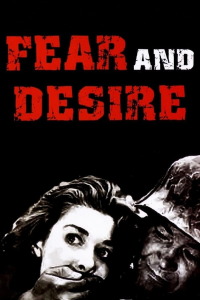
Fear and Desire explores the familiar idea of war stripping away our ability to be logical and instead becomes enticed and swallowed by our primitive desires. It is a psychological subject that I am always willing to sit through as there is something inherently interesting about the human condition within the most horrifying places. Here we have four soldiers stuck behind enemy lines and they must find a way to escape, to be free from danger and to be back in a familiar place and way of life. As their stay in this territory becomes longer, they start to lose a part of themselves and some eventually reaching boiling point, completely breaking down that hard barrier that protects our sanity.
It is Kubrick's amateurish execution that prevents the film from being deep. We can see these characters suffering but he displays it in such a way that rarely ever breaks through our skin, I was constantly aware that I am a spectator of their journey rather than a companion. It also shows Kubrick attempting to use his skills as a still photographer through its cinematography but sadly it feels overly forced, with ridiculously tight close-ups that covey very little. It also does not help that the film was edited in a way that does not pay too much attention for continuity, constantly taking me aback from the story.
There was never a sense of danger depicted on screen, even during moments where violence and sexual tension is openly displayed. It is due to Kubrick not being able to confidently show these scenes in the way he wants it to be shown, the moral and ethical restriction during that time in Hollywood may have prevented him from achieving that but it also could be the fact that his inexperience and lack of confidence have resorted him in fast and erratic cutting. The director thankfully proves to us later in his career that he has a wonderful imagination for violence and how it could be conveyed with depth and intelligence; A Clockwork Orange, Full Metal Jacket, Paths of Glory, and The Shining are primary examples of that.
The film's musical score, composed by Gerald Fried, was at times so overbearing that it constantly distracted me from what was being shown on screen. It tries so hard to create tension, but since the friction depicted on screen is more internal than external, then the score should be more subtle and quietly frightening rather than being explosive and bombastic.
To top it all off, the acting in this film ranged from mediocre to atrocious, with Paul Mazursky being so frustrating with his over the top movements and facial expressions. It was like as if Kubrick had too many things going on as a director, that acting was the last aspect of production he focused on.
Fear and Desire is a complicated film that would have best suited the director if handled with more experience and awareness. If the director started off with a project that was smaller and less ambitious then he wouldn't have been so disappointed with final result, and he probably wouldn't have locked it away from the public for such a long period of time.
This review of Fear and Desire (1953) was written by Chris Q on 17 Dec 2014.
Fear and Desire has generally received mixed reviews.
Was this review helpful?