Review of Eyes Without a Face (1960) by Sparrow J — 24 Feb 2011
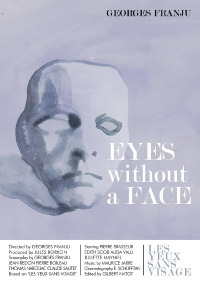
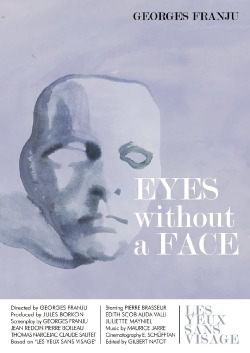
Eyes Without a Face (1959), which was dubbed in English and released as The Horror Chamber of Dr. Faustus, is a dreamy and surreal black-and-white film with sparkling visual clarity and haunting imagery. The story is of a beautiful young girl who has lost her face in a car accident caused by her domineering father. Her father is also a brilliant surgeon and willing to go to any lengths to set right what he has ruined so he begins kidnapping young girls to steal their faces and graft them on to his daughter's.
Despite the lack of blood (in an interview, Franju comments that he could not have blood so that the film would pass the French censors, could not have torture of animals so that he would pass English censors, and could not have a mad doctor so that he would pass German censors (who were still quite sensitive about Mengele-like topics so soon after WWII) the surgery scenes are chilling yet mesmerizing. We know that the doctor is lifting a latex mask, not the girl's actual face, but the movie is so dream-like and enchanting that we are willing to agree that he is peeling away the very identity of a human in order to bestow it upon his daughter.
His daughter is the most poignant victim in all of this. She does not want to destroy other girls so that she can have a face again. In fact, she asks to be allowed to quietly die instead. Her face, when we see it, is filled with a deep sorrow that manages to project beyond the emotionless mask she wears throughout most of the movie. She is a gentle and haunted soul, floating waif-like about the doctor's opulent villa. She is an elegant creature of pure sorrow and twisted beauty.
While Eyes Without a Face has some pacing problems and I'm ambivalent about the carnival-like score, it certainly deserves its status as a classic of cinema. Many express the belief that this film has been overlooked too often and I would have to agree. I only heard of its existence this year. But I believe the film should be listed as one of the greats and should be more well-known, especially among fans of older art films. I do agree with those who say that Eyes Without a Face should rank with Jean Cocteau's Beauty and the Beast for its visual qualities and fairy-tale storytelling ... except that the fairy tale in Eyes Without a Face is a tale with as much sorrow as Cocteau's tale has joy.
The Criterion disc includes another short film by Georges Franju that I will review here as well:
Blood of the Beasts is a short documentary, about twenty minutes long. While I have seen other reviewers refer to this film as "surreal," I would be more inclined to categorize it as "hyperreal.".
The subject is the slaughterhouses of Paris at the time of production (1949) and the topic is treated with a gentleness and honesty that stand strongly juxtaposed against the graphic nature of the images depicted.
Franju begins the film by showing us the edges of Paris. At that time, the gates of Paris opened onto empty countryside and we see a makeshift flea market with strange and wonderful goods for sale. We see children playing Ring of Rosies against a foreground of broken springs. We see lovers strolling and kissing and a great happiness out on the edge of town.
Then the narration moves toward the city and the industrial section there on its edge. We visit several slaughterhouses and, other than the sterility of the black-and-white film, we are spared nothing in watching the animals die. Sensitive viewers will not want to approach this film at all and the rest of us will likely feel a twinge of sadness as we watch beautiful animals become food.
Yet simultaneously, one is pulled in by the efficiency of the workers and the fascinating process by which a neighing or bleating creature on four legs becomes a cutlet. The workers do not betray any emotions, whether of regret or even boredom. They are workers doing their job, just as any other, yet instead of fastening bolts or adding columns of numbers they are butchering animals.
The narrator admires the workers and mentions several times how dangerous their work is. We see a butcher with a peg leg because he once cut a femoral artery while skinning a horse and his leg had to be amputated. We see a young man working with a knife so sharp it can cut a cow's leg off as if it were made of butter and are forced to marvel at the risk he takes every day, casually swinging that knife around.
While the film is difficult to watch, it is also beautiful in a very real way. It is the beauty of honesty and anyone who ever puts meat on his plate over the course of a week can cringe from the sights but if he wishes to be as honest as the film, he must admit that it is his own appetite that swings the poleaxe, that pulls the trigger on the bolt gun, that wields the scalpel-sharp knives.
At the end, the movie returns to the pastoral setting of the edges of Paris and we finish with the image of a barge navigating the canal, filmed from an angle so low the boat seems to be cutting a swath through the grassy field itself. Our breathtaking and sometimes painful journey through the places that feed us -- or I should say that fed us as butchering is a much different prospect these days -- has come to an end.
I watched a brief interview in which Franju discusses his intent in making this brutal yet hauntingly beautiful film. He explained that he intentionally did not film it in color because he wanted to pull the viewer in, not push them away with repugnance. In color, the stark and strange beauty would have become nothing less than repulsive. Franju realized that he wanted the film to be beautiful but his sense of beauty is a sense of truth, not of loveliness. He was seeking an honesty toward his subject that, I feel, he did achieve. As for sandwiching the horrors of the slaughterhouse with the loveliness of a sunny day on the outskirts of Paris? He felt that an object is not fully realized until we can place it in its setting and that the setting itself de-objectifies the object and helps lead us to a fuller truth.
This is definitely not a film for everyone. I would go so far as to say it is a film that only a select few will truly appreciate. But those who can appreciate the life-giving death and the calm assuredness of the men who bring this sustaining flesh to us will come away from the film with a deep sense of awe and wonder. If you have the stomach and sinew to watch where your meat comes from, this film will show you with honesty, respect, and a transcendant beauty.
This review of Eyes Without a Face (1960) was written by Sparrow J on 24 Feb 2011.
Eyes Without a Face has generally received very positive reviews.
Was this review helpful?