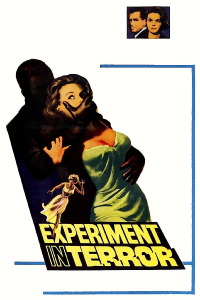
Review of Experiment in Terror (1962) by Blake P — 27 Jan 2016
I've found that some filmmakers make their best movies when working outside the genre they've come to be acclaimed for. Woody Allen scoffed at fanciful comedy for arrant drama in 1978's "Interiors," Alfred Hitchcock walked away from the straight thriller for the malevolent slasher flick with 1960's "Psycho," and Adam McKay turned a blind eye from silly comedy by making one of the most acclaimed films of 2015, "The Big Short." A test of talent can solidify a director's notoriety.
Known mostly for screwball comedies ("The Pink Panther," "The Great Race"), Blake Edwards defied preconceived ideas circling around his works by broadening his strengths in 1962, through "Days of Wine and Roses" and "Experiment in Terror," both starring Lee Remick. Dramas of high stature, they came at the beginning of Edwards's enduring professional career yet aren't what normally comes to mind when his name is uttered, surely because Audrey Hepburn vehicle "Breakfast at Tiffany's" came only a year before them.
But "Experiment in Terror" is perhaps the most overlooked of the bunch, being that it is more evasively escapist than it is glowing and confessional. A psychological thriller of the film noir camp and starring a wrinkled Glenn Ford, it is nothing more than a big screen TV-movie-of-the-week in the mood for a couple chords of suspense. But, being murkily stylish and innovative in its inky imagery, it convinces us that it is a pulse-pounder of more merit than we'd like to admit, partly because it reminds us just what an alluring genre noir can be (visually, that is) and partly because we are tempted to succumb to the stocky artifice of its dialogue and acting. We've seen it all before, but that doesn't mean it doesn't have a few tricks up its sleeve.
Its success has much to do with its story, which, while being TV-movie-of-the-week in concept, is still effective in pulling us into its web of intrigue. The film opens with the stunning Kelly Sherwood (Remick) pulling her white convertible into her California home's driveway, the night sky clear and unassuming. But her otherwise routine day is stabbed in the throat when the garage door seemingly closes by itself; seconds later, an asthmatic intruder lets himself be known. Grabbing our heroine by the neck into a chokehold, he makes his intentions clear: in a few days time, she will steal thousands from the bank in which she works, delivering the money to him without pause. Cause trouble, and she, along with her teenage sister (Stefanie Powers), will die.
But while Kelly is understandably terrified, she is no fool. Immediately contacting the FBI and using conversational tactics that avoid suspicion (her terrorizer always seems to be listening, watching), agent John Ripley (Ford) is assigned to the case, which initially seems simple to its core. But because Kelly never had a good look at his mug, the criminal's identity is impossible to decipher - and it doesn't help that he is much more than your dim-witted bad guy, ahead of every step, every precaution, the FBI takes to protect Kelly and her sister.
Admittedly, "Experiment in Terror" is too long (at two hours) and doesn't bear as many plot twists as we'd hope it'd have (we become convinced that Kelly might know more than she lets on, which is, unfortunately, not the truth). It's a decently average game of cat-and-mouse told with top-notch style, brought to life by actors who could go through the motions of the plot in their sleep. I especially admired Ross Martin's portrayal of the mastermind behind Kelly's predicament, which is wheezy and menacing yet somehow contains a hint of humanity.
It doesn't hurt that the film is also aided by a Henry Mancini score, which has the power to make any movie have the aroma of something metropolitan, something regally dangerous. Edwards's direction is rigid, and the climactic chase, set in Candlestick Park, showcases noir filmmaking at its most grandiose. Just don't expect a masterpiece - take away its style and star power and you get unimpressive formula. Good formula, though.
This review of Experiment in Terror (1962) was written by Blake P on 27 Jan 2016.
Experiment in Terror has generally received positive reviews.
Was this review helpful?