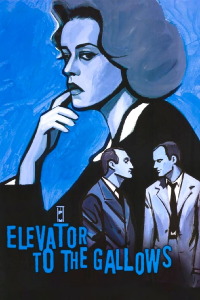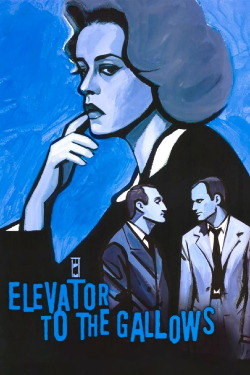
Review of Elevator to the Gallows (1958) by Kevin R — 18 Aug 2015
The doomed lovers of 1958's "Elevator to the Gallows" do not find their erotic passion lost in a smoke of underlying deception. Their erotic passion is cloaked in the love Walter Neff dreamed of: quivering, gauzy, potent. But it's obstructed by the presence of an unwanted husband, a husband perhaps too sensitive, too vengeful, to simply divorce. Murder, it seems, is the only way to live happily ever after, even if all roads end in a blazing afterlife.
The lovers are Julien (Maurice Ronet) and Florence (Jeanne Moreau), her husband powerful business magnate Simon Carala (Jean Well). She married young, putting comfort ahead of adoration; Julien, incidentally, resides under her husband's employment. They aren't planning to off the man for his money - they figure the publicity, the ruthlessness of her husband would be catastrophic in their relationship. So they come up with a foolproof plan: while Florence waits around in a chic Parisian café, Julien, pretending to go back up to his office for a few after hour tasks, will instead climb up to Carala's work space, shoot him point blank, and stage it as if it were a suicide.
It is the perfect murder, and is, for the most part, carried out with finesse only paralleled by the most experienced of assassins. After the deed is done and the suspicions of his coworkers go untouched, Julien treads back to his convertible as if nothing is off, cool as a cucumber. But just as his foot steps on the gas, he notices that the grapple hook he used to climb into Carala's office remains. Though it's bound to eventually fall and go unnoticed by investigators, Julien's paranoia manages to seep into his common sense - so he decides to barge back into the building at the last moment, figuring that taking a chance poses too many risks. But as he takes the elevator back up to his office, the very worst possible scenario becomes a reality when the security guard shuts off the electricity and leaves our sympathetic killer trapped in the confines of the shaft.
Florence waits for what feels like days, wandering around the city while hiding her internal despair, letting rain pour onto her poreless facsimile as she gives numb face to the empty chill of the night. Did the lover she once trusted betray her?
"Elevator to the Gallows", the directorial debut of Louis Malle, is a mood piece years ahead of its time, its Miles Davis scored, glacial black-and-white assimilating it into something nearly futuristic in its slippery minimalism. It's film noir at its most downbeat, its most bewitching; the midnight streets of the city are seductively "The Third Man", and the murder is an act of love tattered by true affection rather than the artificial sort of "Double Indemnity". "Elevator to the Gallows" is so elegantly dangerous because it's the kind of film where everything goes wrong; perfection is cheap. It's the alarm of an unexpected deviation that beguiles.
The central romance between Julien and Florence diffuses a sort of efficacy only found in the love stories of forgotten classics - their devotion to one another makes the stake riddled surroundings all the more agonizing because we want them to end up together. Their crime is not a part of a double-cross or a scheme; it's an act of despondency fueled by desire. The side-plot, which focuses on the attractive teenage couple (Georges Poujouly, Yori Bertin) that steals Julien's car, commits murder, attempts suicide, and gets him framed, is so gripping only because it so eccentrically reflects the plight of the main anti-heroes. While the latter couple plans everything methodically yet doesn't get away with it, the former acts on haphazard instinct and glides by with ludicrous success. It's an irony Malle sees through with an utmost tragic eye.
But "Elevator to the Gallows" is stylish, sophisticated entertainment meant to bridge the gap between thriller style and the heaviness of crime and its side effects. In the end, our eyes are more pleased than our intellectual pangs (it's much more captivating to gaze upon Moreau's masterfully understated performance than consider the reality of it all), but "Elevator to the Gallows" is a noir less 1958 and more timeless - its efficiency has not aged.
This review of Elevator to the Gallows (1958) was written by Kevin R on 18 Aug 2015.
Elevator to the Gallows has generally received very positive reviews.
Was this review helpful?