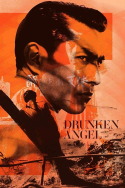
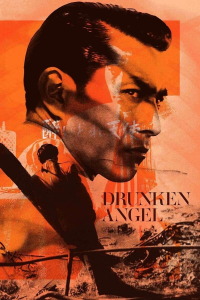
Review of Drunken Angel (1948) by Marco F — 05 Mar 2009
This is a film that should appeal to educated film fans, and rightfully so, as a gangster film by Kurosawa. One cannot argue that it doesnâ??t sound tastey. However, one cannot simply expect a yakuza action film. The expected tendencies of the genre steer and punctuate a more somber and operatic framework while Toshiro Mifune's lost character weakens, not only because of his mingling with the wrong crowd but due to the illness he suffers that impairs his time to contemplate his life. It boasts theatricality as do many of Kurosawaâ??s unabashedly Japanese traditionalist films, thought not to such extremes as Ran, Kagemusha or Rashomon, but that is in the behavior and acting, where the film itself delivers post-war realism that Kurosawa urgently expresses.
An alcoholic doctor treats a young, petty hood played by a quietly intense Toshiro Mifune, marking his first role with Kurosawa, after a clash with a competing syndicate. The doctor diagnoses him with tuberculosis, and talks him into being treated for it. The two experience an uneasy sporadic acquaintance until Mifune's ex-boss is released from prison and inscrutably orders to reconvene his crew. Mifune then ignores his treatment, slides back into old habits and threatens to kill him, while his life is further endangered by his gangster lifestyle.
Takashi Shimura plays the doctor, an unsympathetic character to balance the audience's natural affection for doctors against its natural distrust of underworld gangsters. Kurosawaâ??s sense of justice is very strong, and he knew that for the film to work the audience must feel sorry for the gangster caught in a battle between his destructive way of life and his physical health. As the action rises, Kurosawa intermingles the violence of a gangster film with the struggle of the individual to disentangle himself from his violent standard of living. As he is pressed to do in earlier instances, Mifuneâ??s naïve Yakuza has to take off now from a scuffle when his growing ailment overpowers him. There is a superb climactic scene of struggle on the floor of an apartment hallway covered in white paint, symbolism and dramatic technique, new camera angles and musical score.
And it's not just the partnership of Mifune and Kurosawa. There is also Shimura, the doctor who can't refrain from drinking, even as he tries to help the people around him who seem to be developing a motley crew of bad diseases from contaminated water. Mifune goes to the doctor, who rejects him, having complete disdain for his kind. In the course of the film, the two powerful actors depict these people as weak but severe, and alternately hostile and empathetic.
This review of Drunken Angel (1948) was written by Marco F on 05 Mar 2009.
Drunken Angel has generally received very positive reviews.
Was this review helpful?