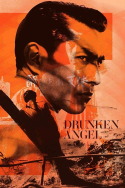
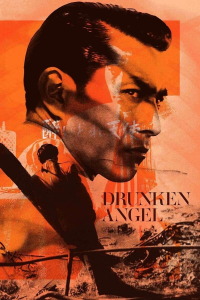
Review of Drunken Angel (1948) by Craig K — 28 Dec 2007
Filmed only three years after the end of World War II, Kurosawa Akiraâ??s Drunken takes place within the filthy confines of shanty town marketplace where a heavily polluted swamp dominates the scenery. Within this black market, gangsters rule through their money and weapons, controlling the flow of alcohol, drugs, and rations. However, even within such a dismal place there are some bright spots, even if that bright spot is an alcoholic, scruffy doctor.
Drunken Angel opens with Matsunaga, Mifune Toshiro, coming to the office of Dr. Sanada. He claims that his hand was accidentally slammed in a door, and when the doctor notices that it is also bleeding, he states that there was also a nail. Dr. Sanada, without using painkillers, digs into the wound with a pair of tweezers and eventually finds a bullet and he eventually cleans the wound up and bandages it. Because he has a cough, Matsunaga asks the doctor to give him some medicine. However, the doctor states that Matsunaga should get himself checked for tuberculosis since his â??high lifestyleâ?? leaves him a prime candidate to catch the disease. Dr. Sanada does a halfhearted examination with his stethoscope, it is halfhearted because x-rays are necessary to detect the beginnings of tuberculosis, and he soon discovers a fist-sized hole in Matsunagaâ??s lungs. Matsunaga is angered by the news, but this occurrence soon begins a tenuous friendship between Dr. Sanada and Matsunaga. The often drunk doctor not only wants to save Matsunaga from his tuberculosis, but from the environment in which he lives: as a member of the yakuza he is tied to a feudalistic code of â??honorâ?? that ties him to a continuous circle of murder and revenge. However, there is something else as well that the doctor hopes to save Matsunaga from.
After World War II came to a close, The Occupation Forces led by SCAP, Supreme Commander of the Allied Powers controlled basically all forms of media, including books and films. When a new film was beginning production, the producers of the film had to send a short synopsis to the Civil Censorship Detachment which cut certain aspects of the film if it had anti-American sentiments, depicted remnants of World War II, the black market, etc., and encouraged the filmmakers to include such things as the different classes working together, anti-feudalistic ideals, kissing, etc. Kurosawa, often considered one of the most â??Westernâ?? of filmmakers, was in fact quite against Western ideals, i.e. American, ideals forced on Japan and slowness in which the occupation forces restored Japan to a habitable level. The yakuza in the film are the ones who have truly embraced the West. Matsunaga wears an aloha shirt and sports Western-tailored suits, he drinks Western liquor, and dances to jazz music. The dangerous Okada also quickly embraces Western dress after he is released from prison. The filthy swamp could be seen not only as the result of the devastation caused by World War II, but also as a continuous stagnation of the country as long as the American forces were present.
While often not listed as one of his best films, Drunken Angel marks a deviation from earlier films such as No Regrets for Our Youth (1946) and One Wonderful Sunday (1946) which held closer to the standards and ideals established by SCAP.
This review of Drunken Angel (1948) was written by Craig K on 28 Dec 2007.
Drunken Angel has generally received very positive reviews.
Was this review helpful?