Review of Drive (2011) by Blake P — 01 Sep 2015
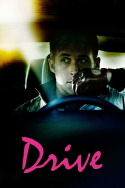
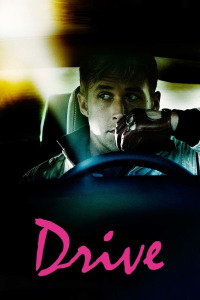
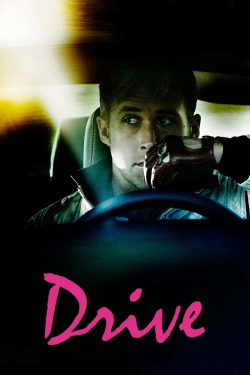
Nicolas Winding Refn's "Drive" is a metallic hotbed of ultra-violent neo-noir, blanketed by visually orgasmic imagery and a leading hero who might consider himself cooler than Steve McQueen if he ever took time off driving stunt cars and getaway vehicles just to sit back and watch "Bullitt". It's a film more interested in looking and feeling like a thriller, not compelled to lay a foundation for surface level style to attach to or make the stakes of the high-stakes plot seem, well, high. But like De Palma's "Dressed to Kill", it has a filmmaker at its head confident enough to choose execution over conception - and, putting its many detractions aside, it, for the most part, works.
Ryan Gosling stars as an unnamed driver who, by day, does stunt work for minor Hollywood productions, and, by night, works as a getaway driver for immoral criminals. To call him a hero or a villain would be a mistake - he sees his sordid second line of work as a job, nothing more. He resorts to violence only when the situation calls for it.
Mostly emotional barren, The Driver's purposefully lonely life is unexpectedly thrust out of whack when he begins a friendship with his lovely neighbor, Irene (Carey Mulligan), a single mother deeply affected by the return of her criminal husband, Standard (Oscar Isaac), who has just released from prison. As his feelings for Irene grow, The Driver decides to aid Standard in a robbery meant to pay for his protection money - but as things spiral out of control and it appears that the people in charge of the plot are far more dangerous than they seem, he is forced to keep Irene and her son out of harm's way as deadly thugs chases after him.
As "Drive" escalates into progressively violent territory during its final act, much of the earlier, ominously quixotic shininess rusts - what begins as a noir with much in common with an updated spaghetti western (its loyalties lying with silence, danger, and intoxicating enigma) turns into an epically bloody excursion into sadism. The subtlety of its initial parts gives one the sense that we will see as little as possible, Refn providing much of the meat while we use our own intellect to provide the filler (Refn gives us the character, we their background, he a couple of car chases, we a consideration of past events not shown by the camera). But the way everything remains so understated as the violence nearly explodes off screen is jarring; it's like it's more meant to shock than enhance the stylistic embraces of the film.
But even as it descends into places I would rather it not go, there is no denying the strange power "Drive" holds. It takes us into a place where only an artificial sun shines and even the most trusted of people hold shady pasts; crime is so prominent that hope seems like a distant land. Car chases are not mere pieces of technological savviness but real danger; they feel alive. Silence, prevalent like in "The Good, the Bad, and the Ugly", is stabbing instead of empty. Refn's directorial assurance is hypnotizing; Gosling, a leading man perfect for this sort of film, feels like a descendant of Clint Eastwood. A lot more of "Drive" works than what doesn't - it's just a touted masterpiece more problematic than a touted masterpiece should be.
This review of Drive (2011) was written by Blake P on 01 Sep 2015.
Drive has generally received very positive reviews.
Was this review helpful?