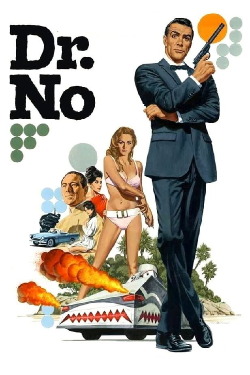
Review of Dr. No (1962) by Van R — 17 Mar 2010
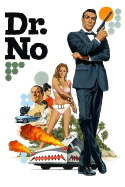
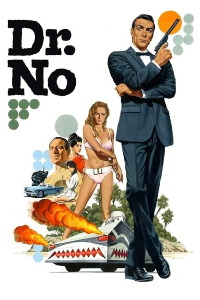
The first entry in the James Bond franchise, Terence Young's "Dr. No," has a rough hewn urgency about it not only in Young's lean, muscular helming of the exotic, larger-than-life, derring-do hijinks in the Caribbean but also in Sean Connery's snappy, no-nonsense performance. Young never lets the momentum lapse in this straightforward, high-tech thriller. The 1958 Ian Fleming novel concerned super villain Dr. No's dastardly efforts to sabotage American missile tests. The Richard Miabaum, Berkeley Mather, and Joanna Harwood screenplay doesn't depart drastically from Fleming's source material. Six differences, however, crop up. First, Dr. No is tampering with NASA's Mercury project by toppling, i.e., throwing the gyroscopic controls of a guided missile off-balance, rather than just interfering with a generic missile launch. Second, Bond battled a squid at Dr. No's island fortress in the novel, but he doesn't tangle with any sea beasts in the film. Third, a centipede crawled over Bond's body in the novel, whereas a tarantula creeps across him in the movie. Fourth, Dr. No drowns in a pool of radioactive coolant pool rather than dies in a pile of guano. Fifth, in the book, Dr. No has such anatomical peculiarities as his heart on the wrong side, enabling him to survive an assassination attempt by rival fractions. Sixth, Leiter isn't in the novel.
Unlike later 007 adventures, "Dr. No" lacks a pre-credit sequence, but the film does open with the traditional gun barrel. The man in the gun barrel, however, is not Sean Connery, but stunt man Bob Simmons. Simmons continued to appear in the gun barrel until "Thunderball" when producers Harry Saltzman and Albert R. Broccoli adopted the widescreen format. The film does a credible job of intertwining exposition with action so that the action never stalls. Incidentally, the Bond producers called on another actress to dub Ursula Andress's voice. Saltzman and Broccoli were definitely ambitious with their meager million dollar budget. Ken Adam's setsâ??even on this threadbare budgetâ??remain larger-than-life, especially the atmospheric room where Professor Dent collects the spider. Bond's journey through the air ducts on Dr. No's island is appropriately menacing, too. He gets drenched, shocked, and steamed. The spider in his bed is a suspenseful touch, despite the obvious Plexiglas between Connery and the arachnid. Lenser Ted Moore photography is crisp and captures the scenery of Jamaica.
John Strangways (Tim Moxon) leaves his bridge game at his club to transmit his daily message to London. Before he can leave the parking lot, the three blind black beggars pour lead into him with their silenced automatic pistols. They shoot him at least five times and sling his body in a hearse. Later, they show up at his office and murder his secretary after she has opened the frequency to send a message to London. The communications department makes a note of the failure of Jamaica to transmit anything but a signal and passes the information along to their superiors. The chief of British MI-7, M (Bernard Lee), dispatches his top field agent, James Bond (Sean Connery), to Jamaica to investigate the deaths of these two employees. Similarly, "Live and Let Die" opened with the deaths of three British agents in or near the Caribbean and M sent Bond out to check up on them. No sooner does Bond arrive in Jamaica than he attracts attention from a photographer and finds a chauffeur with a car awaiting him. Bond checks with Government House and learns that the authorities did not send the chauffeur, so our hero plays along until he exposes the driver. At the same time, Bond discovers that he is being followed and tells the chauffeur to lose their pursuers.
Eventually, Bond meets CIA agent Felix Leiter (Jack Lord) who has been assigned to the case. NASA plans to launch another rocket and our heroes must take care of Dr. No. Bond uncovers a leak in Government House in the pretty form of a secretary, Miss Taro. He has a date with her, inevitable off-screen sex, and then exposes her as a traitor and has the authorities arrest her. Professor Dent (Anthony Dawson) who was playing bridge with Strangways lies to Bond about rock samples that Strangways found on Dr. No's island. The rocks are contaminated with radioactive material. Miss Taro and Dent conspire to kill 007, but he thwarts their plans.
One of the scenes that United Artists objected to at first involved Bond's killing of Professor Dent in Miss Taro's bungalow. Professor Dent emptied his Smith & Wesson into what he believed was Bond asleep in Miss Taro's bed, only to discover 007 sitting on the blind side of the door with his own gun aimed at Dent. During Bond's brief but pointless interrogation of Dent, the evil professor exploits an opportunity to recover his weapon when Bond looks away for a moment. Dent shoots but his gun clicks on empty. "That's a Smith & Wesson," Bond reminds him, "and you've had your six." Bond asks him who he works for and then shoots him dead. United Artists were initially horrified because it looked like murder, but the Bond producers persuaded them to allow the scene to stay as it was.
Of course, the problem with all Bond movies is that 007 cannot die. The strength or weakness of this franchise lays in those cliffhanger situations and how closely the villains come to killing Bond. Further, the hero must work to triumph over his adversaries and the ease with which the hero succeeds reflects the film's strength.
Joseph Wiseman does a splendid job as the dispassionate Dr. No. who resembles Fu Manchu. He works for SPECTRE and despises all governments. Bond and he struggle in the end in his command center after 007 overheats the radioactive core. Ursula Andress looks beautiful in her two-piece bathing suit when she walks up onto the beach and that in itself proves sufficient. "Dr. No" qualified as a modest start for a great franchise.
This review of Dr. No (1962) was written by Van R on 17 Mar 2010.
Dr. No has generally received very positive reviews.
Was this review helpful?