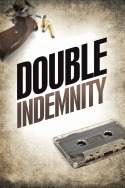
Review of Double Indemnity (1973) by Gary T — 10 Oct 2014
WOW.....WOW.....WOW....WOW....WOW....BRILLIANT......THRILLING.....AMAZING......GENIUS.....FANTASTIC.....STUPENDOUS.......AMAZINGLY BRILLIANT.....MAN JUST SEEN THIS MOVIE 4 THE 1ST TIME N THINK THAT THIS IS SUCH A FANTASTIC MOVIE 2 WATCH.....ITS GOT A GOOD CAST OF ACTORS/ACTRESSESS THROUGHOUT THIS MOVIE.....I think that Barbara stanwyck (.R.I.P.), fred macmurray (.R.I.P.), Edward g robinson (.R.I.P.),porter hall (.R.I.P.), jean heather (.R.I.P.), play good roles/parts throughout this movie......I think that the director of this drama/classics/thriller movie had done a great job of directing this movie because you never know what 2 expect throughout this movie......man this is such a thrilling movie 2 watch, its got a great cast throughout this movie......I think that this is such a really well written/acted/directed movie 2 watch......its got a brilliant cast throughout this movie.....
Background.
James M. Cain based his novella on a 1927 murder perpetrated by a married Queens, New York woman and her lover whose trial he attended while working as a journalist in New York. In that crime, Ruth Snyder persuaded her boyfriend, Judd Gray, to kill her husband Albert after having him take out a big insurance policy - with a double-indemnity clause. The murderers were quickly identified, arrested and convicted. The front page photo of Snyder's execution in the electric chair at Sing Sing has been called the most famous newsphoto of the 1920s.
Double Indemnity began making the rounds in Hollywood shortly after it was published in Liberty magazine in 1935. Cain had already made a name for himself the year before with The Postman Always Rings Twice, a story of murder and passion between a migrant worker and the unhappy wife of a café owner. Cain's agent sent copies of the novella to all the major studios and within days, MGM, Warner Bros., Paramount, 20th Century-Fox, and Columbia were all competing to buy the rights for $25,000. Then a letter went out from Joseph Breen at the Hays Office, and the studios withdrew their bids as one. In it Breen warned:
The general low tone and sordid flavor of this story makes it, in our judgment, thoroughly unacceptable for screen presentation before mixed audiences in the theater. I am sure you will agree that it is most important...to avoid what the code calls "the hardening of audiences," especially those who are young and impressionable, to the thought and fact of crime.
Eight years later Double Indemnity was included in a collection of Cain's works entitled Three of a Kind. Paramount executive Joseph Sistrom thought the material would be perfect for Wilder and they bought the rights for $15,000. Paramount resubmitted the script to the Hays Office, but the response was nearly identical to the one eight years earlier. Wilder, Paramount executive William Dozier, and Sistrom decided to move forward anyway. They submitted a film treatment crafted by Wilder and his writing partner Charles Brackett, and this time the Hays Office approved the project with only a few objections: the portrayal of the disposal of the body, a proposed gas-chamber execution scene, and the skimpiness of the towel worn by the female lead in her first scene.
Cain forever after maintained that Joseph Breen owed him $10,000 for vetoing the property back in 1935 when he would have received $25,000.
Exteriors of the Dietrichson house in the film were shot at a 3,200-square-foot (300 m2), Spanish Colonial Revival house built in 1927. The house can still be seen today and is located at 6301 Quebec Drive in the Beachwood Canyon neighborhood of Los Angeles. The production team copied the interior of the house, including the spiral staircase, almost exactly on a soundstage at Paramount.
The exterior of the train station in the film was the Mission Revival Style Southern Pacific Railroad Depot in Glendale, California built in 1923. The station can now be seen as part of the Glendale Transportation Center and was added to the National Register of Historic Places on May 2, 1997.
Other locations around Los Angeles used in the film were an apartment building at 1825 N. Kingsley Drive in Hollywood where Walter Neff lived and the building on the southwest corner of Hollywood Blvd. and Western. That building still stands, but the Newman Drug Store originally on the ground floor is no longer there.
Double Indemnity opened on September 6, 1944 and was an immediate hit with audiences - despite a campaign by singer Kate Smith imploring the public to stay away on moral grounds. As James M. Cain recalled, "...there was a little trouble caused by this fat girl, Kate Smith, who carried on a propaganda asking people to stay away from the picture. Her advertisement probably put a million dollars on its gross.".
Reviews from the critics were largely positive, though the content of the story made some uncomfortable. While some reviewers found the story implausible and disturbing, others praised it as an original thriller. In his mixed review of the film in The New York Times, film critic Bosley Crowther called the picture "...Steadily diverting, despite its monotonous pace and length." He complained that the two lead characters "...lack the attractiveness to render their fate of emotional consequence," but also felt the movie possessed a "...realism reminiscent of the bite of past French films.".
Howard Barnes at the New York Herald Tribune was much more enthusiastic, calling Double Indemnity "...one of the most vital and arresting films of the year," and praising Wilder's "...magnificent direction and a whale of a script." The trade paper Variety, meanwhile, said the film "...sets a new standard for screen treatment in its category.".
Influential radio host and Hearst paper columnist Louella Parsons would go even further, saying, "Double Indemnity is the finest picture of its kind ever made, and I make that flat statement without any fear of getting indigestion later from eating my words.".
Philip K. Scheur, the Los Angeles Times movie critic, ranked it with The Human Comedy, The Maltese Falcon, and Citizen Kane as Hollywood trailblazers, while Alfred Hitchcock himself wrote Wilder that "Since Double Indemnity, the two most important words in motion pictures are 'Billy' and 'Wilder'".
The film's critical reputation has only grown over the years. In 1977, notably terse critic-historian Leslie Halliwell gave it an unusual 4-star (top) rating, and wrote: "Brilliantly filmed and incisively written, perfectly capturing the decayed Los Angeles atmosphere of a Chandler novel, but using a simpler story and more substantial characters." In his 1998 review, film critic Roger Ebert praised director Wilder and cinematographer Seitz. He wrote, "The photography by John F. Seitz helped develop the noir style of sharp-edged shadows and shots, strange angles and lonely Edward Hopper settings.".
Man this is such an incredibly really well written/directed/acted movie 2 watch, its got a fantastic cast throughout this movie.....man this is such a brilliant classics movie 2 watch. it is so thrilling it is such a fantastic, movie 2 watch, its got a great cast throughout this movie.....man this is such a brilliant movie 2 watch, it is such a fantastic movie 2 watch.....
This review of Double Indemnity (1973) was written by Gary T on 10 Oct 2014.
Double Indemnity has generally received positive reviews.
Was this review helpful?