Review of Doctor Zhivago (1965) by Devon B — 22 Jan 2010
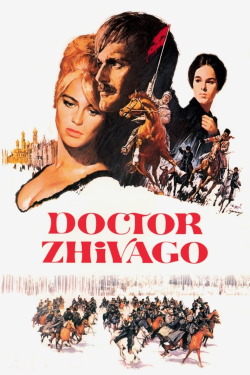
Doctor Zhivago is a sprawling, three-and-a-half hour epic involving the lives of three lovers trapped in the Soviet Union around the time of the Russian revolution. I'm not sure whether the revolution is the backdrop of the love story, or the love story is the backdrop for the revolution, as both aspects are integral to the film.
The movie begins with Doctor Zhivago's brother (Alec Guinness), a high ranking officer, is looking for his brother's long lost daughter. When he finds the girl he suspects of being his niece, he tells her the story of her parents, of how her father was both a poet and a doctor, and her mother was his muse.
As he tells the story, one gets the sense of Dr. Zhivago the family man and physician, but never a sense of who he is as a person. It's obvious he cares for things, but not why he does. He marries the woman who is basically his adopted sister, and he seems to genuinely love her, but the relationship isn't defined beyond that.
He supports the communist revolution, but only in it's vaguest terms. He seems to have no determination in his life, other than in the poetry he writes. That's the one thing that moves him above all else.
His muse, Lara (Julie Christie) leads quite a different life. She's driven by passion, from her affair with the amoral and sadistic Komarovsky (Rod Steiger), to her engagement to the young idealist, who believes in black or white moral absolutes.
Neither of them is quite what they claim they are. When the young idealist is struck down by the Czar's soldiers, he takes a more hardline stance. It's his story that provides a snapshot of the revolution, that maybe communism is motivated more by revenge than by justice.
During WWI, Zhivago is shipped to the front to provide medical care, and it's here he meets Lara for the first time. Their parting after the war is uneventful and Zhivago returns home to his wife to find their home has been co-opted by the government, and they are now sharing it with several other families.
Zhivago takes it all in stride, trying to be supportive of the new government, but he soon grows weary of watching his family starve and freeze to death. After he's nearly arrested for taking some old fence boards for firewood, the family heads off to the adopted father's country estate.
They find the government has also taken that home, but not the servant's shack, and so they set up house in that instead. But really, there's no safe place in the new Soviet Union. As one leading party member tells a soldier, after the battles are over, it's the police who will maintain the government, not the soldiers, and thus begins the campaing to stamp out free thought.
As I've said before, Doctor Zhivago is really two movies in one, the story of a man caught in a love triangle and the story of the Russian revolution. I think the revolution aspect works a little bit better, but both are well done.
David Lean's directing style is reminiscent of 40s film noir, especially the way he lights the actors' eyes in certain scenes, but he also makes visual reference to other epics that have gone before, such as Gone With The Wind.
Omar Shariff's performance is subtle, yet also intense. It seems like an incongruous combination, but he does all his acting with his eyes. I used the word "sprawling" before, and while it can apply to most "epics", it's especially true of this one.
It's not as focused as Lean's other works ("Bridge on the River Kwai", "Lawrence of Arabia"), and I don't think it could have been. It's a film that was meant to be spread out and around.
Even so, it's incredibly absorbing to watch.
This review of Doctor Zhivago (1965) was written by Devon B on 22 Jan 2010.
Doctor Zhivago has generally received very positive reviews.
Was this review helpful?