Review of Delicatessen (1991) by Prabal P — 08 Aug 2010
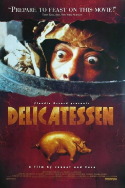
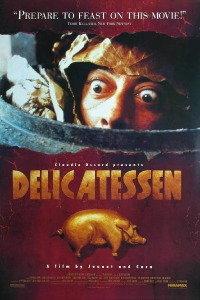
I do not usually give films five stars, but this is a worthy exception. Quite possibly the most brilliant film of the 90s. It is dark, bizarre, beautiful and disgustingly hilarious! There is not a dull moment in this film. When it isn't comedy, it is suspense and when it is not sci-fi, it is romantic. The French have always been masters at juggling genres in their work, much like the main character of the clown Louison, they give their audiences unforgettable performances.
Set in a post-apocalyptic France, the story is one of survival, however in a more associative form. Instead of those classic types of wasteland movies seemingly always set in America where the only place people flock to is the desert... this world of chaos happens in a ruined city where people live as best they can. Everything seems to be somewhat fine, the only real problem now is that meat is in very short supply. It is used as currency, where people trade valuables to get a taste of flesh. As the story cannot truly revolve around the entire country, director Jean-Pierre Jeunet sets his lens on one particular tenement building. Within the first five minutes, a young man mysteriously trying to escape via the garbage cans is sliced and diced. Soon afterwards it is pretty much made known that the proprietor of this building is killing off certain residents and selling their meat at a cost to the rest of the tenement. Usually, the customers wouldn't know what they are being fed, only in this building, it is actually part of the "rules." Everyone is in on it. Cue in Louison, an out-of-work clown who responds to a want ad from this building. He is a young and charming man with no real animosity towards anyone, and he soon plays a part in every crucial tenant's lives. All the while unknowingly being prepped up to become tomorrow's lunch.
There are so many brilliant things in this film, whether it be the use of the completely oblivious man as "the hero," or the bizarre yet completely artistic and confined images that uniquely describe the times these characters live in, this film screams originality. Much like Terry Gilliam's Brazil (1985) or Guillermo del Toro's Pan's Labyrinth (2006), the dark shots still have so much integrity that the whole viewing experience is such a pleasure to watch. The camera goes through the floors of the building, transporting itself through air ducts and pipes, even going beneath the city itself into the canals that have been a staple in Parisian tourism and history for years. The brilliant cinematography by Darius Khondji (Se7en) helps Jeunet and Marc Caro's vision come to light, not only by his mastery of framing, but planning each shot to be perfectly paced according to the overall mood of each scene. When there is something dreadful happening, the camera takes a near-Hitchockian turn, while there is something more sentimental going on, the shot then moves slowly and gracefully (the scene detecting the squeaking bedspring is a fine example of this).
The film also plays out like a large-scale nightmare. On top of the sci-fi angle, there is a real horrifying presence. In an age where we all seem to be ruled by Burger Kings and MacDonald's and putting a name on our meat, the behavior of these individuals cannot be far from the truth if we were to run out of meat to consume. At first the cannibalistic tenants seem somewhat civilized as they are merely trying to survive, but once the proprietor starts to rear his ugly head in his occupants' lives, the savagery of man is really shown in all its glory. The performances of every character, whether it be Dominique Pinon as Louison and Marie-Laure Dougnac's Mary, who play the film's lovely good guys to the evil portrayal of the Butcher/Landlord by Jean-Clade Dreyfus, show a simple yet totally complex disguise for what drives us as human beings. It could be love, it could be hunger, but for some of these people, there is no middle ground. Underneath it all is talks of a group of radicals who are not meat-eaters, and these "freaks" are the ones actually being hunted. It is a clear statement on the dietary habits we tend to have, where the clash between the vegetarian and carnivorous lifestyles are shown in a more violent contrast for the sake of fiction.
On top of all this is a pretty adventurous love story. Louison is quite taken with the landlord's daughter, Julie (Dougnac), who is shy and blind as a bat without her large glasses. And Louison is not the best-looking of men, but once the threat of death looms over their heads, this awkward romance takes a turn for the adventurous as the suspense builds up. It is more of a relationship geared towards helping rather than physicality. The other relationships explored are also quite interesting as there are husbands and wives, children, fathers and sons, mentally depressed people and recluses all living under one roof. Yet there seems to be hardly any privacy in this building. Each one somehow limits the other from accomplishing certain things, like suicide for example. Yet this all builds up to the comedic relationships explored in this otherwise brilliant film.
If there is one film worth seeing that has never been done before or been aped so far, Delicatessen should be at the top of any list. Interestingly enough, as soon as I turned off this film, McDonald's was advertising the "new" Third-Pounder burger... let us be warned.
This review of Delicatessen (1991) was written by Prabal P on 08 Aug 2010.
Delicatessen has generally received very positive reviews.
Was this review helpful?