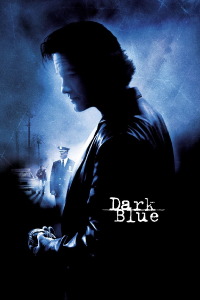
Review of Dark Blue (2002) by Adam J — 27 Oct 2007
I've got an awful lot of law enforcement related DVDs in my collection, and an awful lot of them deal with race or corruption. There are some exceptions (Bullitt, for instance) but I'd say that probably covers the majority that focus on cops in some way or other. I own chunks of some of the biggest and best law enforcement television shows (Homicide: Life on the Street, NYPD Blue, Hill Street Blues) with a definite bias toward street cops and detectives over things like CSI groups. I'm not a fan of either approach to cops, the belief that they are infallible or the belief that they are inevitably fallible. I prefer films that suggest both elements are present, or don't get into it, but as I already said, most of the ones I own do address it.
I'd say it's no real secret that this film is about corrupt cops. Kurt Russell is Eldon Perry, a veteran cop training rookie Bobby Keough (Scott Speedman) in the ways he knows from his long-time police family, which are less than orthodox and also less than legal. He works primarily through Jack Van Meter (Brendan Gleeson), head of their Special Investigations Squad (SIS) and friend to Perry's father. We open the film to footage of the Rodney King beating, establishing the tone, location and time for the film as the early 90s, in a time of extreme tension in Los Angeles. We see Perry anxious and pacing in a hotel room as the verdicts are about to come in. We then begin trading back and forth between scenes of Keough being interviewed by a shooting board to determine the legality of a shooting he participated in and the violent robbery of a Korean man's convenience store by Darryl Orchard (Kurupt) and Gary Sidwell (Dash Mihok), involving the theft of a wall safe and the cold-blooded murder of multiple bystanders.
Keough is naturally found to be within policy for the shooting (otherwise, what would he be doing through the rest of the movie?) and Perry congratulates him in a back office with the company of Van Meter and James Barcomb (Jonathan Banks, who you've probably seen before in any number of bit parts from Airplane! to Gremlins to Beverly Hills Cop, as well as plenty of television guest spots) who clearly feel the shooting--no matter what the circumstances--was the right thing to be done. Before too long, we see Van Meter visit Orchard and Sidwell (!) and demand the money they stole. Now, of course, we know that Van Meter is not acting in any interest but his own (Gleeson is altogether too good at roles like this, though he at least also has roles like Frank in 28 Days Later, though here he has restrained his natural Irish accent until he's left with just strong sibilants and pronounced d's and t's), and see a slightly different slant on things.
SIS, specifically Perry and Keough, are assigned the convenience store robbery--dubbed the "Jack of Hearts" killings--and Van Meter works to steer them away from his henchmen, but Perry is convinced he knows who the culprits are, especially after discovering through a guy on the street ("Maniac" played by the great Master P) that Henry Kim, owner of the store, has a less simple and clean background than he thought, and that the only surviving witness has identified the perpetrators as one white man and one black man.
From here we start to spiral into three intersecting stories--that of Perry and Keough's investigation, Van Meter's attempts to direct them, and the final one, as yet unmentioned: Ving Rhames is an up-and-coming assistant Chief of Police and he smells corruption in the department. As yet he has been able to do little to stop it and is disheartened but persistent. Working for him is Michael Michele (who Homicide fans may remember as Detective Sheppard--funny, because I thought "Who is that? I remember her as a cop or something before, and she is good at the part...") who is currently involved with Keough.
It felt, to me, like an amalgamation of Colors and Narc, though the team of Speedman and Russell is not near so strong as Duvall and Penn or Liotta and Patric. I wasn't disappointed with either (disappointed with Russell?! How could that happen?! Well, ok, Big Trouble in Little China disappointed me, but oh well) but it was still not up to that level. But it was a good story, with an EXTREMELY tense final half hour (and a very impressive shootout that had me thoroughly tense, a rarity these days, and an outcome that I actually was surprised at the quality of performance in) and an interesting mix of the real events surrounding the King trial and riots. The riots do look and feel pretty real and intense, which was good to see, as that is something that can easily fall apart.
Lastly, the score: it's similar, in some ways, to the very cold, bleak electronic score of Narc, though not quite as forlornly, depressingly beautiful (and the songs are the likes of NWA and Eazy-E, rather than Tricky and the Baby Namboos doing the heartbreakingly beautiful "Provoked"). It's very fitting and a good thing to have, and the gangsta rap chosen is well-chosen and well-placed. Not a disappointment at all, in my opinion, and not overly biased for or against cops as anything but humans like the rest of us. Even Perry ends up described by events as more misguided than evil, though he does show racist tendencies.
This review of Dark Blue (2002) was written by Adam J on 27 Oct 2007.
Dark Blue has generally received positive reviews.
Was this review helpful?