Review of Cold War (2018) by Bertaut1 — 21 Dec 2018
Aesthetically perfect, narratively frustrating.
Reading around some of the reviews of Zimna wojna [Cold War], I recognise that this should have been a film I liked, as so much of what critics are praising are exactly the kinds of things I myself often look for in a film. Indeed, I freely acknowledge there's a huge amount to praise here, with elements of the mise en scène borderline genius. However, all the aesthetic brilliance in the world doesn't hide what, for me, is its single greatest flaw - I just didn't care about the two main characters, and I didn't buy their relationship. I'm aware that emotional detachment is exactly what it was going for, and it's probably unfair to criticise a film for successfully doing what it intended to do, but when it ended, all I could think was "meh." Although, to be fair, that may say more about myself than the film.
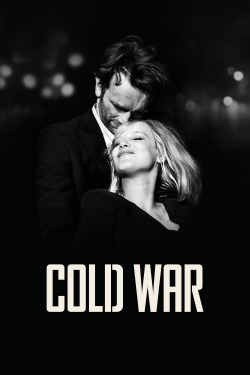
Written by Paweł Pawlikowski, Janusz Głowacki, and Piotr Borkowski, and directed by Pawlikowski, the film begins in Poland in 1949, two years since a communist government came to power. Composer and pianist Wiktor (Tomasz Kot), his ethnomusicologist producer Irena (Agata Kulesza), and state-sponsored overseer Kaczmarek (Borys Szyc) are travelling through rural communities attempting to find recruits for a folk music school. Wiktor is bored out of his mind, until a young woman named Zula (Joanna Kulig) auditions. Although she doesn't fit the profile of what they are looking for, Wiktor argues that she has "something different." Soon enough, he and Zula are in a relationship. The rest of the film takes place over 20 years and four countries (Poland, France, Yugoslavia, and East Germany), but it never branches out from the central relationship.
To begin with some aspects which I liked. The film's aesthetic is absolutely unparalleled, as Pawlikowski and director of photography Łukasz Żal shoot in Academy ratio (1.37:1), which has the effect of confining the characters within the frame. The nature of the film lends itself to sweeping vistas and cityscapes captured in anamorphic (2.39:1), but, instead, Pawlikowski and Żal use the box-like nature of the Academy frame to trap the characters, who don't seem free even when standing in the vast open countryside.
Another example of the film's extraordinary mise en scène is the opening shot, where shallow focus creates a depth of field so small that the village behind the in-focus singers is completely flattened. This renders it visually inaccessible, and thus compels the audience to concentrate fully on the foreground singers. Compare this with the scene where Kaczmarek is giving a speech extolling the glory of the state, all the while a cow is wandering around in the mud behind him. The use of a deeper focus here means that the cow falls within the larger depth of field, and can be clearly seen, once again directing the audience's attention, only this time that attention is directed away from the foreground character as opposed towards him (an, of course, the cow is an important metaphorical element).
So, why did I not enjoy it? At the end of the day, this is a romance. But it doesn't work as a romance. Yes, it's not what you would call a standard romance by any means, the character motivations and justifications that you'd see in other narratives of this ilk are absent, and maybe because of that, although there was undeniable chemistry between the leads, I just didn't buy their insatiable desire for one another. The problem is, the same thing happens about five times - they meet, have a great time, argue over something, and one runs off. And even at only 85 minutes, this kind of structural repetition becomes, well, repetitive.
These are two people who have precious little respect for one another; beneath all the eroticism and physical attraction, they are simply two irreparably damaged people trying to save one another, living with a co-dependency, but instead hastening each other towards destruction. And as I couldn't buy into the believability of the romance, the entire enterprise floundered. And although the end is very well done, and the last line is spectacular, it left me unmoved, because, by that stage, I just didn't care. True, the structure of the film and the tight editing means that events in their lives are glanced at rather than lingered over, so the kind of nuances and character beats you'd expect are absent. By design, the film is barren and emotionally impenetrable, and in that sense, Pawlikowski seems to have been attempting to construct as detached a narrative as he possibly could. If anything, he succeeds too well.
This review of Cold War (2018) was written by Bertaut1 on 21 Dec 2018.
Cold War has generally received very positive reviews.
Was this review helpful?