Review of Cold War (2018) by Markhreviews — 04 Sep 2019
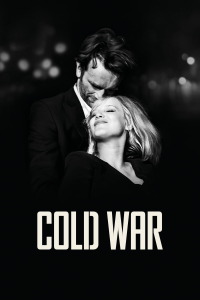
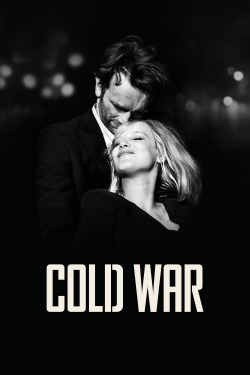
For the average moviegoer, “Cold War” involves heavy lifting under the best of circumstances. It’s shot in black-and-white in Polish with English subtitles.
The film begins in 1949, when Wiktor (Tomasz Kot) and a colleague are traveling around Poland collecting reel-to-reel recordings of indigenous folk songs. Eventually, they develop a state-sponsored program that celebrates Polish culture while eventually genuflecting toward Stalin and Poland’s other oppressors and cold war allies. Along the way, Wiktor selects Zula (Joanna Kulig) as a member of the troupe and, eventually, his lover. After Wiktor defects on a trip to Berlin, they reconnect only to separate in various venues from Yugoslavia to Paris. When Zula decides to flee Paris and return to Poland, Wiktor is willing to go to prison in Poland if he can eventually be by her side. The movie spans the period from 1949 to the mid-1960s.
At its best, this film is stark, yet emotionally rich. In the lead role, Joanna Kulig is riveting. She flourishes in a role written specifically for her by Writer/Director Pawel Pawlikowski. She received the Best Actress award at this year’s European Film Awards. In addition to her impressive acting skills, Kulig also is an accomplished singer, performing folk songs and jazz numbers persuasively. Although his role is more subdued, Kot burns with equal intensity. Together, you can’t keep your eyes off this star-crossed couple. But the whole process is maddening, as the viewer observes, repeatedly, the herculean efforts each will make to be with the other, only to be forced to watch the relationship disintegrate as soon as they are reunited.
Pawlikowski’s script is simply a hot mess. At some points, he seems to be offering a critique of communism and the Eastern Bloc, as the film’s title suggests. At other points, he may be making an existential statement. He also seems to propose that tumult and overt hostility are inevitable in any profound relationship. He gives a glancing blow to the idea that to be human is to be at war with oneself. The overall thesis, apparently, is that life itself is eventually unbearable. This muddle of ideas is perhaps better understood when one realizes that the story is based on the relationship of Pawlikowski’s parents. When they met, she was a ballerina and he a medical student. Throughout their lives, they apparently had a tortured relationship just substantial enough to make the other partner an indispensable antagonist.
The muddled plot makes more pronounced the questionable circumstances under which the primary characters begin their relationship. Wiktor is the conductor and developer of the folk performance. Zula is an interchangeable part in the show. He plucks her out of oblivion at the outset. Given the imbalance of power between the two, it would have been helpful to underline Zula’s willing initial participation, eliminating any impression that she was manipulated or coerced.
As a non-professional filmgoer, I fail to understand why this film has received such acclaim. (It is Poland’s entry at this year’s Oscars. Pawlikowski is nominated for an Oscar for Best Director.) It’s true that the black-and-white imagery is sometimes stunningly memorable and that the performances of Kulig and Kot are exceptional. Unfortunately, ultimately, “Cold War” is eighty-nine minutes in search of a purpose.
This review of Cold War (2018) was written by Markhreviews on 04 Sep 2019.
Cold War has generally received very positive reviews.
Was this review helpful?