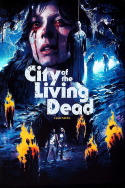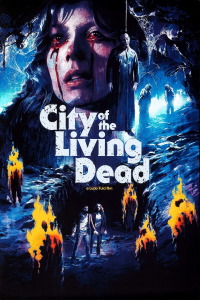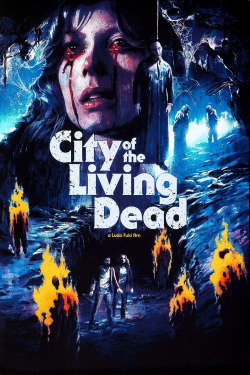
Review of City of the Living Dead (1980) by Carol K — 05 Apr 2007
Not much better than an above-average student film, really. So why does Lucio Fulci have such a devout following?
[QUOTE]In 1979 he achieved his international breakthrough with Zombi II, an excessively bloody zombie film that was marketed in European territories as a sequel to George Romero's Dawn of the Dead. He followed it up with several tales of horror and the supernatural, many also featuring zombies. His features during this time have been described by some critics as the most violent and gory films ever made. City of the Living Dead (1980), The Beyond (1981), The House by the Cemetery (1981), and The New York Ripper (1982) were some of his biggest hits, all of which featured extreme levels of on-screen blood and cruelty.
Several of Fulci's movies were censored by the film distributor to ensure an R rating (such as The Beyond, which was originally released in edited form as Seven Doors of Death) or were released unrated in order to avoid an X-rating (as with Zombi II and The House by the Cemetery), which would have greatly restricted the films' target audience to adults only. The unrated films often played worldwide in drive-ins and grindhouses to hordes of delighted teenagers and horror fanatics.
Many of Fulci's movies were banned in Europe or released in heavily cut versions. Most of his movies became synonymous with video nasties in the 1980's.
Some of Fulci's fans have retroactively argued that at his peak, Fulci's fame and popularity were on a par with that of Dario Argento, another famous Italian horror movie director that Fulci had avoided working with and openly badmouthed. The two finally agreed to collaborate, but Fulci died before the project was finished and the film, M.D.C. - Maschera di Cera (The Wax Mask), was eventually directed by Sergio Stivaletti.
Fulci's films remained generally ignored and/or dismissed by the mainstream critical establishment, who regarded his work as pure exploitation. However, genre fans appreciated his films as being stylish exercises in extreme grue, and later, some of his splatter films (notably The Beyond and House by the Cemetery) began receiving occasional positive critical retrospective notices outside of the Fulci cult. His earlier, lesser-known giallos (notably A Lizard in a Woman's Skin (1971) and Don't Torture a Duckling (1972)), as well as the western Four of the Apocalypse (1975), received some critical acclaim as they became more widely available around the world. [/QUOTE].
[center][size=4]actual - 6.6 [/size].
[/center].
This review of City of the Living Dead (1980) was written by Carol K on 05 Apr 2007.
City of the Living Dead has generally received mixed reviews.
Was this review helpful?