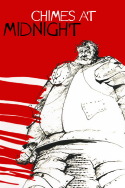
Review of Chimes at Midnight (1965) by Jack G — 01 Feb 2015
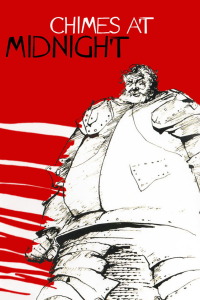
Orson Welles appears in this film larger than ever (ironically, according to the IMDb trivia, he had to slim down to play the role - perhaps there was extra padding, one can only assume). He has the build of a boulder, and the face of the character Hagrid from Harry Potter aged in his 70's. Welles was in his late 40's, turning 50, by the time he took on the role of Sir John "Jack" Falstaff, the man who held his own court and council during the years of Henry the IV, but was sort of an outsider. He was a fool, a liar, a sweet guy who could get the attention of men and woman far and wide - from stutterers to the likes of women played by Jeanne Moreau - and yet he was never really 'apart' of the kingdom, that stuffy place where Henry (as played by a platitudinal John Gielgud) is in ill-health from the beginning of this story - even as he, along with his son the Prince Hal (later Henry the Fifth) - controlled the kingdom from outside invading influences.
I saw the film with someone who didn't really get what many of the characters want or any dimensions to them (outside of Falstaff, who is a force of nature). I can understand it. It's hard to get a handle at times on this story or even some of these characters; some of that, frankly, we can put on the Shakespeare dialog, which is beautiful and beguiling and deep and existential and poetic and, in 21st century times, slippery almost. But for me, the emotional component was always there, and Welles was a Mega-Master of Shakespeare even back in the 1930's (re his productions of Macbeth, Julius Caesar, even the rough draft of this film, Five Kings). So by the time he got to this, rough-hewed as it is, Chimes at Midnight is like his Final Dissertation as a master filmmaker.
Can I just take a moment out to talk how great Welles is here? He commands every second on screen. It can be said he hams it up. Can you blame him really, if it falls into that? I read more depth though in nearly every scene; even in those where Jack Falstaff hears people mock him, he takes it in stride, and can give it as good, or better, than he takes. His tongue is so sharp, and his reactions so BIG, that it's easy to read this as campy. But it's a deeply felt performance, with Welles swallowing this character into his solar plexus. He never plays Falstaff as being as regal as, say, Henry IV, or as Hotspur Percy, who is like many a Game of Thrones character (to put it in modern parlance) who just wants that friggin crown and wants it all his own.
I think the characters know what they want, or are trying to figure it out far as it goes. If there can be a legitimate criticism it's that Baxter, as Hal/young Henry V, is kind of the weak link among the cast. Albeit this is a cast with Welles, Moreau, Gielgud, Fernando Rey in a small but commanding role as another warrior. But he takes up a lot of screen time, and is best when having to do fierce reaction or passive poise - enjoying the company of Falstaff he's fine but but totally convincing. No matter - when someone like Welles or someone like Gielgud or Rodway as Percy or Rutherford as the Mistress mining the place Falstaff calls his court... it makes the journey much more entertaining. When you have a Shakespeare adaptation, especially one as ambitious and wild as this one, you got to have a cast that can pull out the emotional connections. They're here.
And if Welles really pulls out all the stops with his acting - it may even be his dare I say most towering, monolithic work as an actor, with the range going from bawdy comedy and sweet kindness to shattered tragic tones and bewilderment and shock, everything is there - the filmmaking reaches up to it. There is a battle sequence midway through the film as Henry's troops fight oncoming invaders. My God. Just... if you can get a copy of the film, if nothing else that sequence holds up as one of the two or three essential battles on film. There's chaos, there's fast cutting (yet, even with Welles, you always can see what's going on, far as it goes), and yet there's a story going on as Falstaff, who is on the sidelines of the action, tries not to get involved and even plays dead, and Welles is really crafty in cutting back to this. He apparently only had 100 men at a time to work with. He makes it look like triple that - and all the mud and blood that goes with the dirtiness of an epic battle.
It's a filmmaker who loves Shakespeare so deeply, yet he connects it with his own life as an artist and doesn't lose that. It may not matter to some, but I liked that this could be a metaphor for not just Welles but anyone on the margins looking in, unable to break through (especially at the end, as Henry V finally reaches the throne). The energy and force of the direction, the acting, the writing, it triumphs over technical flaws - the syncing of dialog in parts, the fact that parts just connect enough, as it did with Othello in the filmmaking - and in a couple of the performances in spurts. It ranks with the major Welles films, and I do hope it gets to DVD soon (I lucked out with a Welles retrospective that kind of had to play it to be complete) so I can revisit it; I have a feeling, with time, it'll deepen like Kane with appreciation for the craft and ideas on display.
This review of Chimes at Midnight (1965) was written by Jack G on 01 Feb 2015.
Chimes at Midnight has generally received very positive reviews.
Was this review helpful?