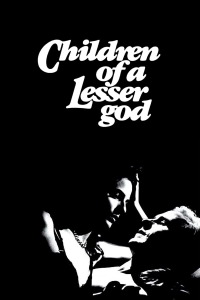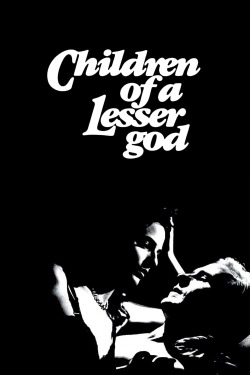
Review of Children of a Lesser God (1986) by Mandy B — 09 Nov 2007
I bought this movie knowing essentialy nothing of it except that it was well thought of, and eventually that it involved deafness. When I hear something like that, my stomach immediately ties in knots--are people saying it's good because it is, or because they don't want to be perceived as cruelly prejudiced? Putting the DVD in, I expected to sit back to either a glorified afternoon special of an extremely artsy, lush, slow-paced movie that constantly turned its nose up at everything.
I was pleasantly surprised by the first scene in the school that James Leeds (William Hurt) has taken a job at. We first see him arriving and talking to the principal (or whatever position of authority it is that Dr. Curtis Franklin (Philip Bosco) holds), but things begin to move once we hit the classroom. Leeds begins by asking who reads lips, saying his signing is rusty. The students stare at him blankly and he says "All right, class dismissed," and neglects to sign this time. They fall for it and he catches them heading for the door. This gives us an overall flavour for the movie's approach--one I was pleased with. It's not trying painfully hard to make the deaf world perfectly clear to the hearing world, nor is it assuming the viewer knows everything about it either. Leeds teaches with energy, trying to use relatable concepts to encourage the nervous, self-conscious students to speak, often making a bit of a fool of himself in the process, but never in that overly cringe-inducing false way.
But, we only see snippets of his classroom, because the real focus of the movie is on his relationship with Sarah Norman (Marlee Matlin), a deaf woman (as in completely deaf) who works as a janitor at the school and attracts his attention with her firey anger and stubborn refusal to connect to anyone. He takes it upon himself to teach her to speak, something he understands backfired in her early years when she first started at the school as a student. The rest of the film is all about their interactions, about the ways they connect and the ways they fail to connect, the things they understand of each other and don't understand of each other, the different worlds and viewpoints they both come from.
Matlin won an Oscar for her role, which I do think was well-deserved. The anger and frustration of Sarah at the way everyone around her sees her (as "broken" and in need of "fixing") is absolutely believable; the way she turns from James constantly, ready to break away at a moment's notice from his presence because she doesn't feel she needs it, because she feels he is like the rest and because she sees him trying to change her, well-intentioned though he is. We can see the hurt she won't even acknowledge herself though, hiding in these angry moments and occasionally coming out in moments of extreme vulnerability, when she sees how happy his singing students make him.
Hurt impressed me more, but only because I knew him as bland, vanilla and less than impressive next to the unrelated-but-similarly-named John Hurt. He always seemed like a really banal choice, sort of like Jeff Bridges--believeable as their characters, even sympathetic, but generally ho-hum and uninteresting. Both have changed my mind (and certainly A History of Violence was a surprise for me as Hurt goes), but this really changed my mind about Hurt. The way he acted in two scenes, making valiant but both failing attempts at understanding Sarah's world was perfect in its complex mix of good intention, awkward confusion and legitimate effort, at least in one of them. At one point, he is stopping to listen to some Bach and no longer finds the same feeling in it with Sarah's inability to hear and appreciate it. She asks him to show her the music, and the sort of uncomfortable effort that follows is just right. You can see him as James, trying to show the emotion the music instills in him, see the self-consciousness of it as he knows how odd he looks, and see that he keeps trying it even as he knows how foolish he looks. The second is a party a friend of Sarah's invites her to, populated near-exclusively by other deaf people. The background, alienated position James takes, the sighing and shrugging is just right for that kind of feeling of exclusion.
There are two things this film is criticized for, and the first I think is lunacy. The score I was actually quite keen on from the outset, mostly synthetic strings, ebbing and flowing as if water, generally holding in an overall area of tone and pitch, wafting back and forth between. I didn't feel any dating to it, and despite my love for the decade, I am well aware of that feeling (some of the other music, of course, was definitely dated, but that's appropriate in the context of a party in a school set at that time). The other criticism is levelled at the decision to have Leeds repeat aloud (almost) everything that Sarah signs to him. Some feel (like my old conceptual nemesis Ebert) that it would have been better subtitled. Honestly, I did expect that, but felt it would push the film into the snobbery I referened as the alternative to overblown afternoon special. It feels natural (more impressiveness from Hurt for me) and real, and is mentioned in passing as having legitimate reason. I don't think subtitles would have worked correctly. I liked how it turned out and enjoyed it quite thoroughly. I prefer stage dramas that are really turned into movies, and you have to remove dialogue from scenes and place it somewhere else in your head to see how it would have worked on stage. Simply putting it into real places instead of sets (or into more realistic sets, at least) is often obvious if the blocking ends up similar and doesn't feel as right as it does on a stage. I also like my romances to be lacking in beat-you-over-the-head conflicts, which certainly this could have been (again, see "overblown afternoon special") but it comes out intelligent and perceptive, showing us Sarah's world at least through James' eyes, even if we can't truly experience it through hers.
This review of Children of a Lesser God (1986) was written by Mandy B on 09 Nov 2007.
Children of a Lesser God has generally received positive reviews.
Was this review helpful?