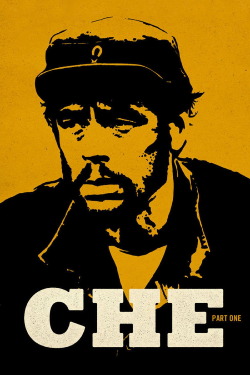
Review of Che: Part One (2008) by James R — 26 Nov 2010
When we first meet Ernesto, the Cuban Revolution is well under way. When we leave him, it is far from finished. That this leaves us no closer to knowing the man than we had been two hours earlier is not a cause for frustration but rather the film's biggest strength. By refusing to either deconstruct or deify an already larger-than-life figure all we are left with is a man's singleminded obsession to overcome, regardless of the personal cost it may entail.
This is not to say the film is apolitical. That would be impossible. The subjects of land reform, healthcare and literacy (the three primary aims of the revolution) are explicitly mentioned at times. Excerpts from Guevara's speech to the United Nations and his response to subsequent interventions by hostile nations operate as the film's structural backbone. The film's focus, however, is on the process of carrying out a revolution as seen through the eyes of a Guevara's guerrila outfit. From the creation of schools to clandestine meetings with other socialist groups, the vast majority of the film is spent not in battle but in the anticipation of battle. Despite a lack of food and the prevalence of disease it becomes clear that his charisma along with the soldiers' unwavering belieft in their ideal keeps them from losing their morale during these extended periods of waiting once the adrenaline from combat has dissipated and fear begins to creep in.
And what of Guevara himself? He knows the names of every soldier in M-26-J and fights in the front lines but he doesn't seem to have a personal relationship with many of them. He places great importance in not leaving anyone behind, making sure that all the men in his outfit can read and that the property and integrity of the peasants they are fighting for are respected. He suffers from crippling asthma but he marches on, and on, and on. Of the man himself we know little. We know what he does and that is enough.
The performances are, on the whole, poor. Most of the actors, being Cuban, both look and sound the part but they are amateurs and their line delivery is often awkward. Demian Bichir, as Fidel Castro, comes across as a parody of his public persona as opposed to a genuine character. Even Del Toro, who has been universally praised, struggles with the accent at times (and the fact spanish hasn't been his primary language for many a year). It is undeniable, however, that he completely looks the part and delivers a performance that is fearless and self effacing in its naturalism. Opting not to rely on crutches or actor's tricks, refusing to chew the scenery or even to draw attention to himself as anything other than one more soldier it is to his credit that the film's clinical, detatched approach works as well as it does.
The photography is beautiful without being showy. The camera even appear to be hidden in the brush much of the time, observing voyeuristically without interfering with the procedings.The film was shot in Spain but its locations, from the rainforests to the colonial architecture, are more than convincing as Cuba. Most importantly, Soderbergh refuses to use conventional "hero" framing. Che is never photographed with the sun as a backdrop, slightly from below or looking directly into the camera with his chest puffed out. The sole exception is during the U.N. speech which, having been shot from the angle of a delegation looking up into the podium, makes it both inevitable and, considering what he is saying at the time and who he is saying it to, particularly effective.
If the film is flawed it is because of its length. It is too short to be either a proper procedural or vignette. Using the U.N. speech as an anchor becomes a necessary evil when there are so many moments missing from set piece to set piece. With another hour (and perhaps the removal of all U.N. footage) it could have been a night impressionistic masterpiece. As it stands, even its more "complete" sequence (the taking of Santa Clara, which takes over 20 minutes of screentime) feels too truncated for its effectiveness to be truly maximized.
This review of Che: Part One (2008) was written by James R on 26 Nov 2010.
Che: Part One has generally received positive reviews.
Was this review helpful?