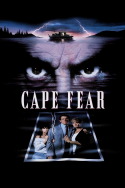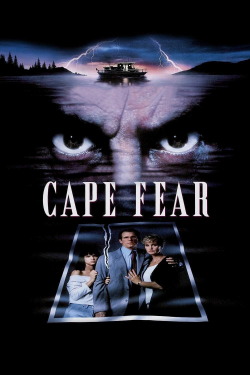
Review of Cape Fear (1991) by Paul Z — 29 Jul 2011
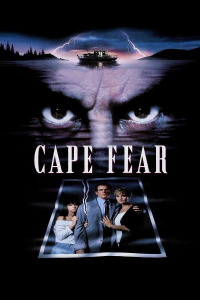
Scorsese's lightning-paced, energetic, dynamic, and nerve-rackingly tense version of J. Lee Thompson's Cape Fear is one of the most atmospherically creative, riveting, and suspenseful thrillers I've ever seen. Scorsese takes a lot of chances with the brazen and aggressive style that he projects. The cinematography is driven by bolting camera dollying, tracking in and out quickly and at fierce angles, at times using lavishly dramatic moving clouds in a gun metal blue or blood red sky. This is a technique that requires very delicate handling and the defining responsibility of the director, something that can easily throw the film out of careful balance by seeming too odd or tongue-in-cheek. However, Scorsese's approach with it grips the audience's attention like an elephant on your couch, intensifying suspense, drama and violence. Unlike the majority of thrillers, Scorsese's Cape Fear has scenes of truly disturbing images and true shocks. The opening credits alone are very moody and creepy, and the use of the late Bernard Herrmann's musical score from the original film does not detract from the feeling. Rather, it heightens it.
The entire cast is aggressive, bold in their own ways, and confrontational. They are all in some sense the primal animalistic core of human nature with that tapering lather of manners on top. Nolte plays an accomplished, organized lawyer and family man, unusually presenting himself with a mild-mannered Clark Kent image, an image that is gradually chiseled away. De Niro, save for his irk-inducing Southern accent, which real Southerners probably laugh at, he is a very convincing monster, a truly terrifying psychopath, not just playing his ordinary mean ol' tough guy gangster. Juliette Lewis, very early in her career, has scenes of great dramatic volume, a mysterious but naive young girl whose weakness for the attention her bickering parents have hardly given her is something she has to fight hard to keep from being exploited. And, though her role is small, Illeana Douglas blows me straight away in the limited amount of screen time she has. She is so real and convincing that she was constantly generating squirms and winces from me.
Cape Fear hits all the right notes. The only folly is the story's giving in to the formula, the cinematic curse, of the warning murder of the dog, which is not a surprise or a twist. Merely, it is the starting point of the villain's wrath. I swear, there is hardly a horror film or suspense film existing now with a dog that isn't killed, and it aggravates me that even such an impressive and important artiste like Scorsese succumbed to it. However, even this flaw is tastefully done, the death being implied and not shown, and inferred as a poisoning rather than a beating or shooting.
The script is very powerful, building intriguingly upon the 1962 version's story. The writer, Wesley Strick, takes about as many chances as Scorsese does with his screaming style by giving each character closely similar personalities, each with a respective guise, and letting them all clash together chaotically. In the original Cape Fear, the story was simple. It was the good, righteous, scrupulous American family against practically the Big Bad Wolf. It worked. But to build upon that story is interesting, and the difference between the 1962 film and the 1991 film is that in the 1991 version, no one is entirely good, righteous, or scrupulous. The image the family has is a delicate glass against the boiling pressure of their inner violence.
This review of Cape Fear (1991) was written by Paul Z on 29 Jul 2011.
Cape Fear has generally received very positive reviews.
Was this review helpful?