Review of Brute Force (1947) by Eric F — 05 Jun 2009
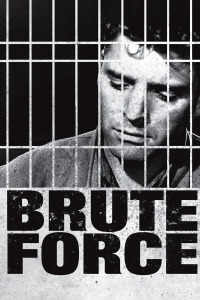
The last line of "Brute Force", a prison escape noir, is "nobody ever escapes". Perhaps director Jules Dassin is using the prison as a microcosm of society under a fascist rule - Captain Munsey (Hume Cronyn) is certainly a manipulative, violent, and power-hungry wretch with an unrivaled control over a group of the enslaved prisoners. Or, perhaps the best way to see it is on a smaller scale. None of the prisoners we meet are bad people - most of them, as we see in flashbacks, ended up in jail because of their unrequited love for a woman. In the United States, we hear that our prisons are packed more thoroughly than any in the world. The film represents a system where even the most loyal men can end up in the prison system which is vile, torturous, and corrupt. A system in which, more importantly, change and rehabilitation is an impossibility. Why "Brute Force" works, however, is because it's equally effective on a completely superficial level, free of metaphor and allegory. It's dialogue is sharp, it's black and white cinematography is stunning, and it has one of the most spectacular climaxes of any movie to come out of the 1940's.
Joe Collins (Burt Lancaster) has just been released from solitary confinement and returns to his friends in cell R17. His punishment was a fluke, due to Captain Munsey ordering an informant, Wilson (James O'Rear), to place a shiv on Collins. Wilson is then killed by prisoners who learn of his associations. When Collins learns that his wife is ill and refuses surgery until she can be with him, he plans an escape to free himself from the tyrannical rule of Munsey. He recruits his cellmates, who each are in love with a woman on the outside, and decides that the escape must take place the following day. Waiting any longer would risk an information leak, and the last thing Collins wants is for Munsey to expect an escape attempt.
Cell R17 has an image of a woman on the wall, and to each of the men it represents their love interest. We see, through flashback, how several of the prisoners came to be captured - one, for instance, brought home a expensive fur coat for his wife to rekindle passion in the relationship. These flashbacks, although being highly entertaining short melodramatic films, are very much unneeded. The claustrophobia of the prison cell is disrupted by such diversions, and the prisoner's intentions could've easily been elaborated upon through the film's sharp dialogue.
Perhaps the best thing about the film is Hume Cronyn's performance. He's an archetypal baddie, however Cronyn is so perfectly cast that his Captain Munsey is as despicable as any villain in film history. He doesn't look particularly intimidating, however through his speeches and one extraordinarily effective torture scene he becomes a legitimately terrifying figure.
This review of Brute Force (1947) was written by Eric F on 05 Jun 2009.
Brute Force has generally received very positive reviews.
Was this review helpful?