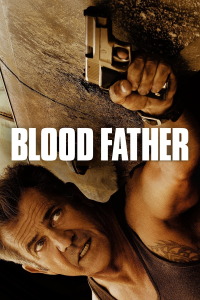
Review of Blood Father (2016) by Troy K — 16 Sep 2016
Putting Mel Gibson back into his status as an action hero with a lead role and earning some strong reviews, Blood Father sounded like a real guilty pleasure.
There was a lot behind Blood Father that suggested that it was goin to be a rip-off of Taken (2008). For one thing, the entire premise of an older man attempting to protect is daughter from criminals is the bare basic plot of the film. Given that Blood Father is also an English-language French action thriller with a director whose claim to fame is crafting functioning action films, everything pointed to one direction. Ultimately, Blood Father went in a significantly different direction to Taken or any of the works of Luc Besson. It was a direction I immensely appreciated as it transcended so many expectations I had about the film. It did have some shortcomings as the character Lydia Link was underdeveloped and there was significantly less action and explosive set pieces than I had hoped for. But the film more than made up for it in many other ways.
The story in Blood Father is a fairly basic one on the surface: Mel Gibson portrays the estranged father of Erin Moriarty and must fight to protect her from a gang. As the formula suggests, this means that there is action, cheap sentimentality and formula. Though there is only a handful of action in the film, the feature is almost utterly bereft of sentimentality. Bent on being as real as it can, the father-daughter relationship at the centre of Blood Father is unlike in any other film; it is extremely realistic. When Lydia Link contacts her father John after not having spoken to him for ages, he doesn't break down into tears or descend into a dramatic monologue about hope. He immediately jumps into ensuring that she is ok and tells her to come home, and that is the start of how we understand their relationship. This proves to be one of the best parts of the film. Mel Gibson portrays a formerly convicted recovering alcoholic full of regrets and anger, essentially in a testament to himself. And the fact that John Link's associate Preacher sells Nazi Memorabilia in the star vehicle for an actor criticised for his anti-Semitic remarks is almost ridiculous enough to be self-aware. Blood Father seems very much to be a testament to Mel Gibson's mistakes and regrets when it comes to characters, and it makes the role all the more believable for him. He is never portrayed as a character of sentimentality, he is a hard-edged and raw man full of anger that he's trying to resist. And to see him pull it all back and focus that intensity into protecting his daughter gives Blood Father emotional power without even a hint of melodrama or sentimentality. The fact that he actually finds himself struggling when in the presence of alcohol shows that the writers clearly had a lot on their mind when creating the character, and it manages to show itself even without spending an excess of time obsessed with cheap characterisation. The relationship shared between John and Lydia Link is a constant struggle to ensure Lydia is ok, and she is never treated like a stereotypical daughter. John approaches her as a friend in need of help, and he never condescends her about it. Despite the father-daughter struggles, there is a strong mutual respect that happens within their interaction, and it develops at a steady rate as a subtextual element within the story. The antagonist is even sympathetic due to his vulnerabilities, so Blood Father comes with a strong sense of humanisation on all ends of the character spectrum. There ends up being one mild sentimental moment at the end, but it is mild enough not to seem cheap while still maintaining a feeling that is completely genuine. Blood Father is a film with great characters and it's direction is extremely consistent, ensuring that Jean Francois-Richet is capable of much greater things than simply the strong action scenes he captured in the remake of Assault on Precinct 13 (2005).
The greatest thing about Blood Father is its tone. Though the film takes itself extremely seriously, it doesn't mess around by trying to develop arbitrary story elements. Instead, it finds a way to do this but also allow audiences to have a fun time with the film. Serious in its grit but lighthearted by script, Blood Father is an extremely fun experience beyond its action value. The characters and their language are nothing short of hilarious. The protagonist is so often frustrated by the world around him that he takes out his anger by cursing it with hilarious frustration, and the choice of words is perfect. Blood Father is not an action comedy, but it is the funniest film I have seen in a long time. This is partially because audiences are not expecting it, but also because it is genuinely clever. And it manages to stay fresh within a film which runs for only 88 minutes, never wearing thin. The sense of humour in Blood Father is the most unsuspecting element of the film and also its most refreshing, and the fact that much of the time it falls upon the dynamic of the father-daughter relationship gives the film a buddy feeling. Mel Gibson playing a badass with a gun in a buddy action-thriller is nothing new; in actual fact, it brilliantly harkens back to Mel Gibson's legacy in the Lethal Weapon series (1987-1999). But it doesn't stop there.
On top of being a testament to Mel Gibson's bad decisions in life, it is also a reminder of the films that made him great. His legacy as an action hero is brought back into the spotlight in one of the best films of his career, a film which made my friend turn to me and say "When did this become Terminator meets Taken?". My response was "I thought it was Ransom meets Mad Max". The consensus is that we were both right. While Blood Father maintains the aforementioned elements of taken with some of the imagery from Terminator 2: Judgement Day (1991), the story itself is very much a combination of Mad Max (1979) and Ransom (1996). The film is a violent contemporary western, much like Mad Max. And Mel Gibson's character's pursuit of rescuing his child from kidnappers is very much an Ransom story point. While Mel Gibson has gotten older and lost some of his credibility, Blood Father provides him the perfect role to remind us why we dislike him as a person and love him as a movie star. The film is most definitely his return to glory, and it leaves me extremely keen to see what the man delivers next.
Blood Father is also a strong experience in the style department. Though clearly not a massive-budget film, Blood Father has an impeccable setting which evokes feelings of western iconography. The cinematography captures the broad scope of the land yet also focuses closely on the actors, and it captures the action sequences perfectly. The action is also edited at a timely rate to disguise none of the violence, ensuring that there is a well-moderated quantity of blood and gore that never gets excessive.
Special praise must also be cowards to the sound editing. Jean Francois-Richet has such faith in the natural drama of the film that he doesn't rely on a musical score to empower it until the end of the film. Up until Blood Father comes to a close, the film relies on the typical western motif of using silence to empower the drama. Building its drama so naturally, Blood Father gives audiences a feeling is isolation by relying on echoes to empower the feeling of emptiness within its western context. When the music does come it is extremely subtle and empowers the film without being too typical in its dramatisation.
The best reason to experience Blood Father is heavily because of Mel Gibson's flawless leading performance. Like I said, the character relates so heavily to the man's real life and the best films of his career that he fits the profile of the role perfectly. Harkening back to his glory days, Mel Gibson steps back into his action hero shoes and displays that he has lost none of his legendary charisma. Playing the badass he gave us in Mad Max while making us laugh like he did in Lethal Weapon, Mel Gibson works so perfectly with the script that he makes the film centre around him. He steals the attention of audiences with his awesome muscular build and angry facial expressions empowered all the more by his raw line delivery. He is a real badass in the most powerful form, yet he still carries a sympathetic feeling to him. It's because he is a clearly flawed human being who acknowledges the wrong nature of his actions while still carrying on, and he does it without forcing hokey tedium through his teeth. He is swift and stern with his line delivery, and the sight of his muscular form gripping a gun is a powerful flash of nostalgia to a greater time. His chemistry with Erin Moriarty is both gripping and funny while his work with William H. Macy provides the film with some of its greatest comical moments. Mel Gibson is just flawless at every moment in Blood Father, and it is an awesome comeback appearance.
Erin Moriarty also brings in a strong performance. The full depth of her character remains unfulfilled by the screenplay, but she supports the part by combining the better aspects of several archetypes and amalgamating them into a singular role. She captures her character's heightened state of stress with an overload of adrenaline, accurately capturing Lydia Link's headspace with intense realism. When Lydia goes on drugs, she doesn't resort to generic sluggishness. She simply disappears into her own mind, laughing her way through everything and refusing the serious nature of it all. Though there is a vulnerable edge to the character, most of the time Erin Moriarty focuses more on being an accurate archetype than a tedious dramatic subplot. She manages to get it accurately, and the lack of character development is compensated for with a very genuine spirit.
Diego Luna makes a strong antagonist due to his inherent flaws, with his humanity being one of them. There is a strong feeling of vulnerability to him, but it doesn't interfere with his strong efforts at antagonism. And William H. Macy is a perfect addition to the cast because his dedication to the white trash archetype makes him immensely likeable and endlessly hilarious. He is a bright spot in a film shines already shines with such significance.
Blood Father has a simplistic story and less action than you might hope, but with a strong mix of gritty western storytelling and consistently hilarious dialogue propelled by Mel Gibson overpowering charisma, it ultimately earns the status of one of the best films of the year.
This review of Blood Father (2016) was written by Troy K on 16 Sep 2016.
Blood Father has generally received positive reviews.
Was this review helpful?