Review of Black Orpheus (1959) by Tina C — 15 Apr 2011
Awfully Sudden for True Love.
When I was a child, I was obsessed with Greek mythology. I even went around one summer giving nicknames to practically everyone I knew, selecting them out of my copy of Isaac Asimov's [i]Words From the Myths[/i]. (To this day, it's one of my favourite books.) I remember very little about the guy I dubbed Orpheus. He was a counselor at Arrowbear Music Camp. His name was Val. He was in a fraternity, and he had to be able to recite the Greek alphabet three times before a match went out in order to get into it. And that's it. I don't even remember what instrument he played. But it is interesting, in retrospect; I seem to recall that he was the most popular of the male counselors with the female campers of an age and inclination to have crushes. The Orpheus here, too, is a bit of a ladies' man, though if our Orpheus has been half so open about pursuing those who were attracted to him, he never would have been a counselor. He was, as I say, in college; I was in junior high.
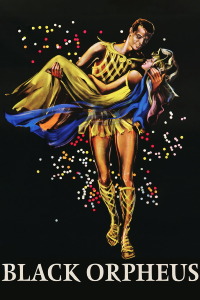
This particular Orpheus (Breno Mello), or Orfeo in the Portuguese, is a trolley conductor. It is Carnival in Rio, and he's going to take his day off and marry Mira (Lourdes de Oliveira), who tells the girls that he finally talked her into it, but it's clearly the other way 'round. The clerk at the marriage license office makes a joke about how Orfeo should be marrying Eurydice instead, and they both look at him blankly. But just before Orfeo got off work, he helped Eurydice (Marpessa Dawn) off his trolley and directed her to the house of her cousin, Serafina (Léa Garcia). It turns out Serafina is in love with Orfeo, too; all the girls are. But Eurydice has not come to Rio in search of love. She is fleeing from her hometown, where a man (Ademar Da Silva) is pursuing her. Serafina says it is because Eurydice is beautiful, and why wouldn't a man be in love with her, but Eurydice says that the man is coming to kill her. She does not know why, but she is certain. And then, she meets Orfeo, who falls in love with her. Mira, of course, is not best pleased with this development.
Apparently, the people of Brazil have not traditionally been as fond of this movie as everyone else. They say, according to what I've read, that it makes it looks as though Rio is just one big party. But it is, after all, Carnival, and it's Carnival for an excellent reason. Costumes form a significant aspect of the plot. Eurydice must be disguised. Some guy must wander around dressed as, and credited as, Death. They must find their way through confusion. Honestly, while Carnival is shown as a party, it's not one I think most people would want to attend. At least not as a principal. Besides, Orfeo and Hermes (Alexandro Constantino) and the clerk at the license bureau still have to go to work. Serafina has spent the last of her money on her costume, and there is an enormous line at the pawn shop of people hocking things to have a little money to celebrate on. The movie makes it quite clear that this is not what these people do every day, I think. It is an extraordinary circumstance which is necessary for events to play out as they do.
We are never told why Eurydice is being followed by Death. Logically, it is because the Eurydice of the original myth died. However, even that stumbles a bit if you remember that there's actually a logical sequence of events which would cause every moment in the story without him. Eurydice is coming to Rio at Carnival; that doesn't need another reason. Mira is extremely jealous, because she is supposed to marry Orfeo, and he is running off with Eurydice instead. And so forth. However, the choice was made to create an otherworldly air. There is the old, blind peddlar at the beginning who gives Eurydice something he cannot even say for sure is pretty. Serafina, Orfeo, and the others live at the end of the line. There is, to symbolize the original Descent Into the Underworld of the original Orpheus, an empty government Missing Persons office. Orfeo takes part in a Macumba ritual where Eurydice inhabits an old woman's body to tell him that he can have her, but only if he never looks at her again. The movie uses these elements to make what would be a fairly prosaic story something, well, mythical.
There is also the matter of Benedito (Jorge Dos Santos) and Zeca (Aurino Cassiano), a pair of local children. Benedito gives Eurydice an amulet at the beginning of the story, and it is implied that its loss is what eventually gives her over into Death's hands. Without its protection, she is lost to her fate. It is also the case that the boys serve as, well, a Greek chorus. As is generally true, children know more than they are expected to by their elders, even when the elders themselves tell them things because, hey, kids. They believe in their hearts that Orfeo plays his guitar to bring the sunrise. Benedito seems almost to fill the place of one of those omnipresent servants of legend, the boys who bear shields for great men. I don't know what Zeca's name means, but "Benedito" can come from "benediction," or blessing. Hermes delivered the news of Eurydice's death, but it is Benedito who is willing to follow Orfeo into the darkness. Benedito blessed Eurydice at the beginning of the story, and the loss of his blessing to her signaled loss for all.
This review of Black Orpheus (1959) was written by Tina C on 15 Apr 2011.
Black Orpheus has generally received very positive reviews.
Was this review helpful?