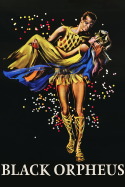
Review of Black Orpheus (1959) by Kim M — 01 Mar 2018
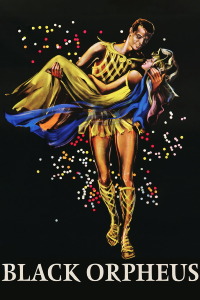
Director Marcel Camus grabs us from the outset in this film, with the energy of samba music playing as women return to their village carrying large containers on their head. Children are scampering about and they're on a hill overlooking Rio de Janiero, surrounded by stunning mountain peaks and beautiful bays below. The film takes the classical tale of Orpheus and Eurydice and adapts it to Brazil at the time of Carnival, and while I liked the mythological reference, it was the setting, cast, and overall vibrancy that really had me enjoying it. How fantastic it is to see all this color and energy in a film from the 1950's. The cinematography is excellent, with those beautiful vistas and sunsets, and quite a few street scenes as well. There's also some great music, with the spontaneous wailing and drumming in the streets offset by a couple of love ballads with touching lyrics.
The central characters of Orfeu and Eurydice are played by Breno Mello and Marpessa Dawn reasonably well, and it was fascinating to me to find out later that Mello had never acted before. Camus saw him on the street and asked him if he wanted to be in a movie, and then he was the star. Orfeu is a ladies man engaged to the vivacious Mira (Lourdes de Oliveira), but he's drawn to the simple purity of Eurydice, who has come to the city for the first time. It's a good-looking cast, and hard not to be drawn by its magnetism. The supporting roles are fine too, starting with Serafina (Léa Garcia) and Chico (Waldemar De Souza), who engage in delightful banter. The two little boys (Jorge Dos Santos and Aurino Cassiano) are also a joy to watch.
Sensitivity surrounds the film, since dancing and partying are stereotypes some hold of Brazilians or people of color in general, e.g. reducing them to simple-minded people who do nothing else. I can see the concern and understand a possible negative reaction, and it carries even greater weight when it comes from Brazilian themselves, or the likes of President Obama. I confess I have not had to live with the consequences of these types of stereotypes, so you can take my opinion for whatever it's worth, but I saw it as a celebration of the culture, and it was fantastic to see the diversity. The characters are not single-dimensional, and I enjoyed seeing the love and tenderness alongside sassy playfulness in the romances. As for the lack of realism, well, it's a Greek myth adapted to Carnival, so it's fantasy by definition - and certainly meant to be a complete view of life in Brazil. You have Death chasing Eurydice around, for goodness sake.
In adapting the myth, I wish it had been more closely tied to the classical story. It's interesting to me that amidst all of the colorful, wild, chaos of Carnival, which is an extreme representation of Life, we have Death so near, and maybe that's one of the points. The film drags a bit towards the end, though the final scene of the three children dancing nicely lightens the tragedy. Overall, well worth watching, and quite a unique film - just be mindful of the sensitivity.
This review of Black Orpheus (1959) was written by Kim M on 01 Mar 2018.
Black Orpheus has generally received very positive reviews.
Was this review helpful?