Review of Ben-Hur (1959) by Cameron J — 29 May 2012
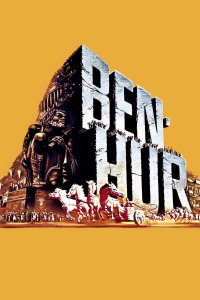
Wow, first Moses, then Ben-Hur and, finally, John the Baptist in "The Greatest Story Ever Told"; Charlton Heston must have been pretty tight with God. Well, maybe it wasn't so much Jesus, as much as it was big, sprawling epics, it's just that after you star in about a hundred, you're bound to hit a religious epic or two, or three, just like if you were an Italian epic filmmaker from the '70s and '80s, you were bound to get Robert De Niro in one of your projects eventually. Shoot, there was no "bound to" to it, because if there was an Italian epic to be made around that time, you can bet your bottom dollar that De Niro was somewhere in it. He was almost like a Charlton Heston of the '70s, only he was a much better actor (Shut up, Heston was hit-or-miss) and hardly anyone went to see his Italian epics, whereas Heston couldn't keep people from seeing his epics, mainly because he was in just about every epic produced in America, and even then, I'd imagine that he was somewhere in the background of epics all across Europe. I can see him just sneaking onto the shooting location for "Seven Samurai" and running by the camera way off in the distance, because he just had to be in every epic, and really, I don't see why, because "The Ten Commandments", followed by this, alone, was about enough sprawling epic for a lifetime, and by that, I mean that those two films alone, pushed together, would run about the length of a lifetime. I'd imagine the critics wouldn't mind, because with this, "Titanic and "Return of the King" all tying for eleven Oscar wins, it would appear that they love a good, long movie, and really, I can't blame them, because this is some good old fashion entertainment, complete with padding and unevenness. Well, needless to say, if the consensus is right about this being pure entertainment, they didn't have the highest standard of fun back then and I'm no nut for this little number like I am for its succeeding unparalleled Oscar-sweeping sweepers, which isn't to say that it's not good, because this is still pretty darn good, yet it is to say that this film isn't without its faults.
Earlier, I jokingly evoked padding as a flaw in this film, when really, that's surprisingly hardly an issue. There is the occasional sequence that perhaps outstays its welcome (Oh man, that chariot race sequence, espcially), yet on the whole, things are relatively tight, and it's a good thing too, because this film spends too much time away from its point as it is. The story is heavily layered in the fashion of episodicity, as the significant happenings in Judah Ben-Hur's life around which this film is centered were wildly dynamic, so it's going to require some effort for this film to not feeling unrelentingly jarring. Well, sure enough, that effort was made and the film's story emerged surprisingly rather organic in its progression, yet it's focus, on the hand, did not emerge spotless, for although the film's focus isn't a jarringly inconsistent, it is decidedly uneven. By the time Ben-Hur hits the chariot races, you forget almost all about his intial false imprisonment, and don't even get me started on how much they go in and out of the aspect of Jesus, whose very birth actually opened this character study on an entirely different person. The film is bloated and ambivalent, with not enough consistency in tone, nor a whole lot of intensity in that tone to begin with, for the film to really deliver as a particularly upstanding epic, when it very easily could have, given its production quality and story worthiness. As it stands, however, the film remains one to watch, standing bold with much of that good old fashion entertainment value at its back, carrying it on to its ultimately satisfying final stance, and getting it there in style.
Robert L. Surtees's Oscar-winning cinematography has obviously dated, yet still has much depth in its coloring and a grand deal of grand sweep in its scope, isolating the grand livliness of this world into a single, awe-inspiring point. It certainly helps that the Oscar-winning production designs and art direction are also pretty top-notch for their time, and, well, still pretty top-notch to this day, being slick and elaborate to make the handful of action sequences thrillingly grand, the environment dazzling and the world, in general, immersive. Wow, this review is starting to sound very same-old-same-old, which actually kind of fits, seeing as how I didn't really emphasize how this film is, like many epics of its type and era, like many epics of its type and era, or at least in tone. The film feels like the same-old-same-old, yet it matters not, as the story, while neither the most unique nor comfortably structured in cinematic epic history, remains riddled with compelling intrigue and dynamic scope, with both fine style and substance married to create a truly resonant story. While its considerable unevenness still stands as the films fall from the graces of ultimately glorious quality, the story is still powerfully engrossing, and it's the worthiness within the story that makes it so resonant, because lord knows the acting isn't doing the job. No, but seriously though, like many of his classic hit-or-miss performances, Charlton Heston's Oscar-winning effort has aged a fair bit, yet still has enough juice in it to involve the audience, based on his charisma, alone. Judah Ben-Hur is initially a noble man, yet one unflinching impact of faith-shaking tragedy after another will test the boundaries of his humanity, and with this film's storytelling sensibilities and its lead's acting sensibilities being so underdeveloped, yet there's still enough depth within William Wyler's direction and Heston's performance, even through all of the melodramatic moaning, to bestow upon the film dramatic intrigue that, when combined with immediate resonance within the fine story and engagement value within the style, renders the film enthralling and consistently entertaining, even with its sprawling and often messily-handled length.
Overall, the limited originality and ever so occasional padding are hardly problematic, especially when compared to the film's true potential squanderer: a bloated and very thematically uneven tone within the overly dynamic story structure, yet with that story still being such a deeply intriguing and sweepingly compelling one that goes generally well told, with relatively effective dramatic depth and grand scope, thoroughly complimented by stellar style and production value, William Wyler's "Ben-Hur" stands as a generally satisfying, classic entertainer of an epic.
3/5 - Good.
This review of Ben-Hur (1959) was written by Cameron J on 29 May 2012.
Ben-Hur has generally received very positive reviews.
Was this review helpful?