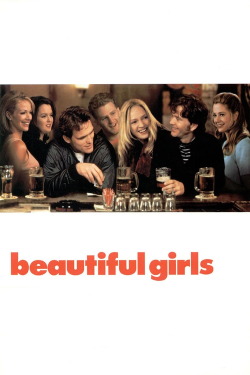
Review of Beautiful Girls (1996) by Russell N — 29 Jan 2009
"In five years you're not gonna remember me. And then I'll be Pooh to your Christopher Robin.".
"That's the saddest thing I've ever heard," says the pond-ice-skating 13-year-old Marty (Natalie Portman) after she professes her affections for 28-year-old Willie (Timothy Hutton), who proceeds to explain what happens when people outgrow things they no longer need.
"But it's true. You'll go through changes. And I can't be a Pooh.".
The best of all high school reunion films, Ted Demme's "Beautiful Girls" takes us to a small town and keeps us there, managing to accomplish this through stark honesty.
In this truly underrated gem, we don't have a protagonist coming home to mom baking cookies and numerous well-to-do siblings talking politics while carrying infants in their bosoms. Here we have Willie (Hutton), a quiet, unassertive piano player who returns to snowy Knight's Ridge, Massachusetts to a lower-middle-class house, a shy, aimless brother (David Arquette) and an uncommunicative widower father (Richard Bright) who after years of his son's absence can only manage to say, "There's some golf on the TV. Do you wanna watch some golf?" We also meet his childhood buddies, including the handsome Birdie (Matt Dillon), the loser Paul (Michael Rapaport), and family man Mo (Noah Emmerich), all of whom are alcoholics, largely out-of-luck in relationships/careers, and have never left Knight's Ridge.
Willie knows the difference. He misses his identity, but knows exactly why he left his one-horse town. He's been a struggling artist in New York for years. He knows himself and his dreams, and to settle for anything less would be a step backward. Still, it's precisely why he's not totally in love with his big city attorney girlfriend, Tracy (Annabeth Gish), and why he is so drawn to the precocious "old soul" Marty (Portman), a teenage girl who inconveniently still rides bikes and builds snowmen in the yard next door. For Willie, Marty is a soulmate, someone who really understands him, a perfect match to complement his complicated heart.
His buddies are slightly less complicated, but no less tortured in their contemplations about identity and happiness. Birdie is neck-deep in an affair with his high school flame Darien (Lauren Holly), who is married with a child. And the clueless Paul can't handle his relationship with Jan (Martha Plimpton) because he's blinded by illusions of what-else-is-out-there, wall-papering his apartment with pictures of "beautiful girls" which to him signify hope. Watch for the bumbling moment where he succumbs and proposes to Jan with a half-assed excuse for an engagement ring. Either plowing snow or drinking beer in every scene, Dillon and Rapaport are pitch-perfect here depicting the comic dramas of blue-collar life.
The women are just as fun. Holly makes for a nasty little villain-- a grown-up version of a "Mean Girl," while Mira Sorvino plays Birdie's loyal-to-a-fault girlfriend who desperately wants to believe he loves her despite his cheating. Uma Thurman makes a brief, memorable appearance as the hifalutin' hot girl from Chicago, and Rosie O'Donnell has a great scene berating the boys as she explains the false illusions of "beautiful girls" at the magazine rack in a drugstore.
But the quintessential scenes are with Willie and Marty. Portman plays the would-be neighborhood Lolita with confidence and deep empathy. Hutton complements her with equal parts of adoration, love and confusion. We know it's totally wrong for them to be an item, but we crave more scenes with them together. We understand their mutual attraction and respect their love. It's really a moving relationship.
But don't forget this is a comedy. And it's got really funny moments, like the boys' rambling diatribes while ice-fishing, accusing one another of eating "retard-sandwiches," or evaluating women on a 1-10 rating scale while playing video games. Because the boys are flawed, we believe they're real people, like neighborhood kids we used to play in little league with. We're totally there when Mo loses it after Birdie gets beat up by Steve Rossmore (Darien's husband). Mo grips Rossmore (Sam Robards) by his collar, throwing him against the wall ready to beat him up, until Rossmore's 5-year-old daughter knocks on the screen door saying "Daddy, what's going on?" At that moment, all the men realize they're not kids anymore. They're adults. They have grown up, even though they don't know how it happened.
Seattle Times' critic John Hartl wrote upon the film's release, "here's a movie where we begin to miss the characters the moment the end credits start to roll" and he's absolutely right. In two hours, I felt like I got to know Willie-boy, Paulie, Birdie, Mo, and the other townies as if I grew up with them. It made me miss my real childhood friends, and it still gets me whenever I think about leaving my 12-year-stint in Los Angeles and heading back to my roots in Seattle. It's a personal film for me, but I'm willing to bet it'll be a charmer for anyone else. I often revisit the film to imagine what life might be like in a smaller town with down-to-earth values. Sometimes that makes me sentimental. But on other occasions I pop this movie in for the same reason I enjoy visiting home-- to spend time with old friends, hang out and chat like nothing else matters, with the luxury of time to really contemplate life. After as many viewings of this movie as I've had, the Knight's Ridge boys have become those old friends.
As Willie leaves in the final scene, one of the guys says from the driver's side of a snowplow window "See ya Willie. Stay cool. Stay cool forever." It's the way those strange moments of parting are expressed in real life. It's bittersweet, but real. Here, we become Willie, driving away and leaving the old home to return to our current life. But still, we're tempted to think about planning our next visit.
This review of Beautiful Girls (1996) was written by Russell N on 29 Jan 2009.
Beautiful Girls has generally received positive reviews.
Was this review helpful?