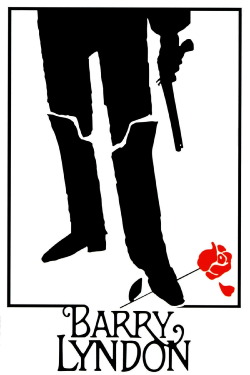
Review of Barry Lyndon (1975) by Edward S — 17 Aug 2012
"Barry Lyndon," in my opinion the apotheosis of Kubrick's oeuvre, is an existential crisis put onto film. At the height of his power and artistic abilities, Kubrick delivers one of the best character studies ever and, visually, one of the best films ever.
Every frame of this movie is a beautiful bucolic, pastoral, 18th century painting. Kubrick develops the mindset of a skilled painter as he mimics nature on film: the edge of the frames displaying tree branches and leaves nostalgically blowing in the wind, candlelight in the center illuminating the characters around it, symmetry, mirror images, skylines, objects in the foreground and distance composing an image, romantic landscapes, natural lightning and plays on shadows, sunlight, sunsets, tumultuous clouds, bright skies, placement of buildings and characters, utilizing bodies of water, etc. The soundtrack, consisting of Handel and Schubert, compliments the images with astonishing perfection.
With an impeccable period backdrop, Kubrick only gets started in literally trapping Redmond Barry, the titular character, into a deterministic, fatalist nightmare which we, as an audience, force him into reliving again and again with every viewing. This is buttressed by the film's featuring an unreliable narrator who spoils every subsequent event of the film (hell, I could probably tell you the entire plot right now and it wouldn't change the experience of watching this film.).
The omniscient narrator consistently utters mundane, instinctual, deriding, and occasionally even inaccurate comments on Barry's actions. Many of these are common views which most of us would also describe Barry as (opportunist, poor sense of judgement, foolish, etc.) Yet, Barry's decisions may as well reflect our own were we in the same position; the droll, rote tone of the narrator puts our own judgement into question, forcing us to come to terms with our Jungian projections. The contrast between Barry's mechanical journey with the gorgeousness of the cinematography, shot compositions, and music (which only we can hear) around him assert a powerful duality between the inevitable inanity of all our lives and our survivalist drive of perceiving beauty and meaning. All the while Kubrick questions our free will, or pokes fun at it, and behavioral aberrations in Barry's fight scene segments, drastically deviating by being shot with a handheld camera, thematically similar to the game-changing lightsaber showdowns at the end of every "Star Wars" film (original trilogy.).
From "2001" we know that Kubrick has an adequate comprehension of human nature and evolution, required for him to put his science fiction spin on it. He subsequently enriches this film with those same ideas of ubiquitous human behavior. An example includes Barry's harsh treatment of Lord Bullingdon, possibly due to the precocious stepson resembling Barry in his youth, a personality which he destroyed in order to gain status and wealth. Or, perhaps, Bullingdon's privileged upbringing and early resistance triggered, in his stepfather, brutal and stubbornly defensive methods obtained by being raised in the Prussian army. Even when these vestigial antics no longer have a pragmatic use, man's overriding nature continually prompts him to conjure them, even when used in the wrong context towards a terribly undeserving victim. Such a cogitation, found only on the tip of the iceberg, just points to Kubrick's staggering achievement of creating a world and an archetypal human being which he has given us the privilege of observing and analyzing for our own benefit.
"I love the use of the color blue by the artist," Barry comments in respect to a painting angled out of view; perhaps a nod from Kubrick that we are also watching an art piece where the characters are rhythmically entwined and positioned by a celestial hand (which would be the doing of our beloved director.).
This review of Barry Lyndon (1975) was written by Edward S on 17 Aug 2012.
Barry Lyndon has generally received very positive reviews.
Was this review helpful?