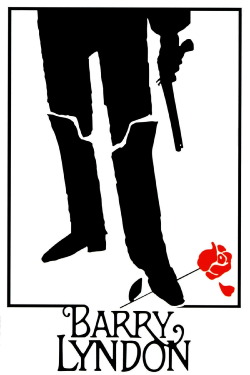
Review of Barry Lyndon (1975) by Jake C — 07 Jul 2018
Of course, everyone who sees this knows already the story about how Kubrick chose to light the film with only natural sources-but consider the effect in a scene like the one where Barry chats late one night in a tent with his avuncular officer. Lit by only a handful of candles, the actors were told to remain as perfectly still as they could muster so as to stay in focus. Or in the many zoom outs, like the one with Barry gazing hopelessly over the edge right after being embarrassed by Bully during the recital: The camera pulls back slowly with Barry kept dead center, perfectly still even as he shrinks in comparison to the wider world just revealed. Or in the duels which bookend Barry's ambitions, always underscored by the same instrumental variation from Handel: Unlike a chaotic gunfight in a mythologized western, here the participants stand utterly motionless, as if dead already.
The point is that this is a film of paralysis, where the lighting, camera movements, stage blocking, and even music contribute to the film's sense of overwhelming stagnation-all this even as the story has a truly (albeit ironically) epic scope, ranging across a lifetime, social classes, combatant countries, Europe in war and in peace. In an age (and a genre of filmmaking) we often look back upon as deeply sincere, of a burgeoning romanticism, and utterly passionate, Kubrick drenches the whole thing in a comic irony truer to the wry spirit of Byron and Thackeray than period pieces ever know to try. A BBC adaptation of Austen or Tolstoy this is not, lacking all pretense of billowing emotion and heartbreaking sensibility.
Rather, Kubrick's choices aim to show the romantic age with romanticizing it, without looking back with the artificial light and gloss of retrospection. What does it mean to portray an era with authenticity? Does it merely mean getting the costuming, the set design, and the specific cant right? For Kubrick-who here is following up his very similar speculative forays into the future-I think veracity means exposing how the accoutrement, the style and look of an age, in fact betray its bones, its spirit (this is all very Hegelian, obviously, and so once more true to the time). And what is more true of this pre-Napoleonic period than its sense of paralysis? It is an era when rising above one's born lot was practically impossible, as it finally is for the futile Barry, whose efforts are for naught in the end. It is an era when women (to say nothing about people of color, who quite literally could say nothing, and so don't here) have absolutely no political or social influence outside the confines of domesticity, utterly stuck in their patriarchal role. It is an era when change-in hat style (a very subtle detail in the second half), in musical variation, even in army uniform and allegiance-is only artificial, ultimately functioning to keep the social system fully in place.
It is Barry's sole redeeming quality, and the thing that makes him both the most modern and the most human character in the whole affair, that he aims throughout for change, to break the cycle of social stagnation and personal paralysis through his great ambition. But Barry is still of his age, and so his efforts come to nothing but his own demise-there is a revolution happening somewhere in the wings, across the pond, but Barry is on the wrong side of things, giving money and men to the King, paying tribute to the phallic master signifier of the ruling order. And so the Oedipal cycle-for of course this all comes down the Oedipal dialectical, the son's attempt to outdo the father and claim the love of the mother (country or personal)-remains unbroken, Bully replacing Barry at Lady Lyndon's side, the (e)state returned to its "proper" lineage in a classically tragic ending.
This review of Barry Lyndon (1975) was written by Jake C on 07 Jul 2018.
Barry Lyndon has generally received very positive reviews.
Was this review helpful?