Review of Baraka (1992) by Robben M — 04 Aug 2009
It's like KOYANISQATSI, except this is better. And also has awesome music.
Okay, so here's how it is...
Imagine the world's greatest visual essay on how people, nature, and the landscapes they inhabit, with great photography, great sounds, music, and the bigness of any 70mm epic.
Actually, this film was filmed in a custom-designed Todd-AO 65mm camera engineered by the film's director, Ron Fricke.
The product of working with Gottfried Reggio (coincidentally, the man responsible for KOYANISQATSI) Fricke decided, after an experimental short film called CHRONOS, that he wanted to push the "non-verbal" film concept to epic lenghts, specifically, that he wanted to shoot it in something akin to 70mm.
Now, all the ideas of nature, humankind, the environment they inhabit, could come to fruition in all its proper glory (let's face it, even though KOYANISQATSI is pretty great, it's not quite the epic Reggio wanted).
But he felt that such a project would be difficult using just a normal camera. He essentially made his own version of the Todd-AO camera; smaller, but still bulky; wide vistas and all the richness of 70mm...
So now, we have BARAKA (A term that can be a blessing in different languages...it's a spiritual term nonethteless).
Filmed in over a hundred locations in twenty countries or so, and it shows. The richness of the environments is so overwhelming you feel as if you are being physically swallowed by the screen itself. It's so powerful you become hypnotized.
The movie itself has absolutely no plot but does have a certain structure for sequences.
For one, the images and subjects center mostly around the natives in their environment, how they find ways to connect with the power of the earth, be it through religion or something, or through the identification in clothing and jewelery and art.
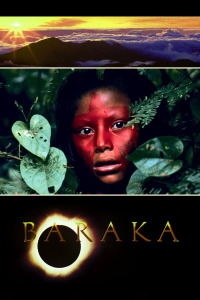
By jumping from country to country, the film develops a sort of universal language, connecting seemingly disparate elements and trying to find ways they are related, be it through visual similarities or through thematic ones (one of the most memorable ones is with a japanese man in a bath standing up, revealing his entirely tatooed body, then immediately cutting to a jungle native with face paint and head-dress...just one of the many wonderful transitions).
In the end, the movie tries to talk about the fundamental spiritual quality of people and how they react to their world, be it through art, spirituality, or violence (as is shown poignantly in the scenes where the camera chillingly tracks through the empty halls of the abandoned concentration camps and the museum of the Tuol Sleng).
There is one particular sequence that stands out though for its sheer bravura and technique. I am of course referring to the 'modern' section, where we see images of cars, time-lapse photography of people rushing up and down through streets, stairs, revolving doors; assembly lines, eggs being filed through, computer circuits being examined, a man going through a dozen mother boards in what may be the most uncomfortable thing to watch; thousands of baby chicks being thrown about in a large converabelt, being picked, prodded, and branded, until we finally see them in the pens as grown chickens; trains full of people rushing out to work, Shibuya being overloaded with thousands of pedestrians, Grand Central Station with billions of blurs and shapes of commuters only barely visible due to the incredibly low speed film used; the coup-de grace is the image of a man in pale white face paint grimacing and finally miming a visage of a person in a horrifice scream, hands squeezing the air; the sound-effects in the back have sirens, cars wailing, and other cacophonies, as if they are affecting this person's very being and soul.
It is piercing and wondrous to say the least. BARAKA does this pretty much every scene, without fail.
In fact, the photography is so good, that you may find yourself swooning too much. What's great is that it never resembles cliche travelogue material. It seems three-dimensional, interesting, textured, and warm. It never feels detached, though it is objective. It is never too flashy, but the techinque does draw approval. It is not heavy-handed, but the messages are heart-felt and you understand.
Compared to KOYANISQATSI, BARAKA is a rousing success. Reggio's pupil has learned well.
BARAKA may well be one of the most important films ever, if nothing else for its incredibly eye and epic scale.
This review of Baraka (1992) was written by Robben M on 04 Aug 2009.
Baraka has generally received very positive reviews.
Was this review helpful?