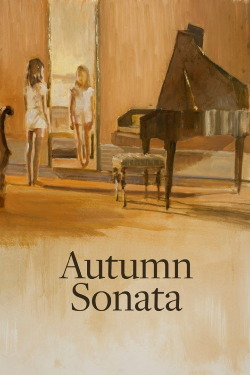
Review of Autumn Sonata (1978) by Edith N — 05 Apr 2011
The Only Double Bergman Film.
In a lot of negative reviews, I tend to say things like "while I have no problem with movies that are just character studies . . . ." Or whatever is relevant to my problem with the movie. I read a defense today of [i]Jeanne Dielman[/i], which I hated, and this shares some of that movie's slow nature. What it has, however, is a raw emotional force. These are women in pain. They have been suffering for many years, each thinking they are contributing to the other's happiness. This, I think, is a theme with Bergman films. The first of his movies that I saw was [i]Cries and Whispers[/i], also starring Liv Ullmann, also the study of a relationship. Here, however, she is not reconciling with her sisters. She is reconciling with her mother, the great Ingrid Bergman, and in true Ingmar Bergman fashion, she is reconciling with herself at the same time. Honestly, his movies may be best when they're character studies.
Ullmann is Eva, the wife of a simple country parson, Viktor (Halvar Björk). Her stepfather, Leonardo (Georg Løkkeberg), has just died, and her mother, Charlotte Andergast (Ingrid Bergman), is coming to visit for the first time in seven years. She has not told Charlotte that her sister, Helena (Lena Nyman), will be there; Charlotte cannot handle her daughter's illness, which is never named but which seems like something in the nature of multiple sclerosis. Eva and Viktor lost a son the day before his fourth birthday, when he drowned, and Charlotte never met him. Charlotte changes her mind about how long she will stay with Eva and Viktor because she cannot stay in the same house as Helena. And then Charlotte wakes from a nightmare, and Eva runs to comfort her. And the two women talk, each telling the other all the things which haven't been said in all the lost and empty years. Things which can never be unsaid.
Ingmar Bergman believed that the human soul is read, and so it is worth noting that one of our first lingering views in this movie is on a bush of faded red roses. Charlotte comes down to dinner wearing a bright red dress. In fact, the DVD itself is red, though I'm not sure why. But this movie, as with the other Bergman I've watched, is about baring the soul. It turns out that both Eva and Charlotte think that the other is harsh and unfeeling. Each reveals her feelings, and there are flashbacks showing what life was like before Eva was married, before the distancing between mother and daughters. It rapidly becomes apparent that Charlotte wasn't really paying attention to the world outside her head and her music. She did not notice the person her daughter actually was, choosing instead to shape her daughter into the person she wanted her daughter to be. And she didn't want the sick daughter at all, of course. Helena wears no red.
This was, of course, Ingrid Bergman's last film appearance. She was actually old enough to be Liv Ullmann's mother, and Liv Ullmann was not in her first youth when this movie was made. However, both women are still beautiful. No, it's not the beauty of Ilsa Lund. It is instead a beauty which has weathered much. After all, Ingrid Bergman's life was not exactly a non-stop party. The years of strain show on her face, but it is clear that they have made her stronger instead of breaking her. Charlotte seems to have managed more because she doesn't let things touch her. Eva calls her emotionally broken, and Ingmar Bergman lights her so the lines are more prominent, which I'm sure thrilled Ingrid. It also appears that Eva is afraid of her own beauty, which is probably why she wears such unflattering clothes and glasses. I'm aware there's this cult about the beauty of Swedish women, but I'm not talking about wanting to see these women, even in their youths, in bikinis. They just have a placidity, really, and extremely pleasing features.
Eva now believes that she will never see her mother again. She believes honesty has now driven her mother away completely. Viktor cannot entirely disagree. And Helena is pretty much ignored, even when she's crawling on the floor and calling for her mother. I do not believe that Helena's illness is psychosomatic. I do not believe it is caused by her mother's neglect. But I do believe that her mother makes things worse. What's more, I don't think having all this out in the open earlier would have kept the distance from forming. Realistically, I'm not even sure it would have kept Eva from wearing clothing she didn't like when she was younger. Eva grew up so aware of her mother's moods that she didn't feel allowed to have her own, and it has ended in her marrying a man she didn't love. And I suspect, based on what happens, that there are a couple of pretty major aspects of her life that she never told that man, either. Honesty can be painful, and Eva has just discovered exactly how painful. She may not want to continue the experiment.
This review of Autumn Sonata (1978) was written by Edith N on 05 Apr 2011.
Autumn Sonata has generally received very positive reviews.
Was this review helpful?