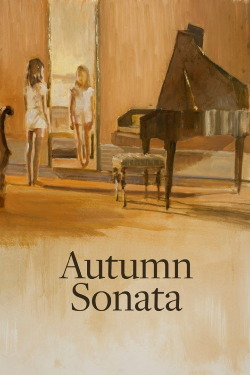
Review of Autumn Sonata (1978) by Ross L — 25 May 2012
Here's a film that affected me deep to my core. The screenplay, direction, performances, and cinematography were all in line to deliver one of Bergman's best. The basic idea is that a mother comes to visit a daughter she hasn't seen in a long time.
These two have deeper problems than they want to admit to themselves until things stir up inside of them. Ingrid Bergman plays Charlotte; a mother who abandoned her family to pursue her career as a pianist.
Liv Ullman plays Eva; the daughter who of Charlotte who has troubles coming to terms with her mother and her childhood. The two women are legitimately happy to see each other again, since it's been such a long time.
They lie to themselves that everything can be perfect; they can look past everything that happened and just be happy to be together. It all starts when Eva realizes Charlotte would not have come for a visit if she knew Helena would be present.
You see, Helena is her daughter that she put in a nursing home once she became handicapped, but Eva brought her home after feeling that she would be happier there. And her own mother didn't want to see her.
Eva starts to think that maybe things won't be different. We get the full scaled effect when Eva plays the piano for her mother and realizes things are the same as they've always been. Her mother doesn't seem too pleased (even though we see her reaction and for me it's still hard to say why she seems torn up while Eva plays the piano) and it bothers her.
It's her own interpretation. Then her mom plays the same thing and it's masterful. I think deep inside, Eva is drawn in amazement to her mother just like when she was a little girl, but she doesn't want to admit this so it makes her angry.
When she was a child, her mother would go on tour for months, or she would practice her piano 6 hours a day and never want to be bothered. She consumed her life with her music. This led to neglect, which is why Eva says that Helena has been handicapped.
Again, people say that this is similar to Bergman's feelings towards his father. It's set in a country house much like one he grew up in when his father first became a pastor. Helena represents the handicap he felt as a child.
Eva probably represents him being neglected by his father when he was consumed with his religion and his troubles to find love. Charlotte would represent his father. But here it's interesting. There's not just one side to this.
It's a difficult story for both. When Charlotte gave up the piano she thought she did well by her family. But Eva tells her she was too domineering and the summe when she was 14 was horrible. She didn't like that her mother was always gone, and she didn't like when her mother was around.
She doesn't know how to reconcile these feelings. Autumn Sonata is a lot of talking between the two characters. They tell us their side of the story, their feelings at the time, and the outbursts they just can't hold in any longer.
It almost seems like Bergman put himself in Charlotte and tried to understand his father a little more here. Autumn Sonata is a flat out masterpiece that's not to be missed.
This review of Autumn Sonata (1978) was written by Ross L on 25 May 2012.
Autumn Sonata has generally received very positive reviews.
Was this review helpful?