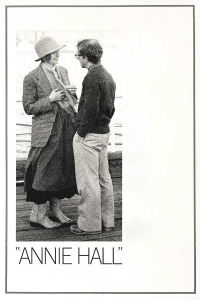
Review of Annie Hall (1977) by Sarah W — 12 Jul 2017
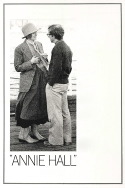
I'm still not sure if Annie Hall represents Woody Allen's mainstream optimism prevailing over his depressive genius, or if it's his usual pessimism going undercover just long enough to cause a long-term cardiac arrest of lovesickness. This was another example of an unreplicable 70s piece that embodied the disappointment of the post-hippie generation, realizing that love can never be completely distilled from sex. Annie Hall, in many respects, was the screen's most infuriating antagonist, at least from a lonely nerd's point of view.
It would be remiss of me not to include my 1970s inspiration, that depressive and quirky old man who was once my age, who defined uncertain love for two generations of moviegoers. I thought it fitting to include Annie Hall as one of cinema's great villains, that is, the woman whom the protagonist always felt he was meant to win-and yet the one that got away. Annie Hall is the perfect representation of the "ex" that you love and hate at the same time, the one antagonist of this list that provokes conflict by eluding the hero, not threatening him. It's impossible to narrow down the great villains or the best sad love lost stories of Woody Allen, but it's fairly easy to identify the one movie that spoke to me as an idolizing, lonely teen. There have been better movies that broke the fourth wall, and dissected their villains and heroes with penetrating insight (such as the works by Charlie Kaufman and Spike Jonze) but Woody Allen was one of the first movie icons to truly explore himself in the objective, cynical way, in this film, not to mention Manhattan and The Purple Rose of Cairo.
This review of Annie Hall (1977) was written by Sarah W on 12 Jul 2017.
Annie Hall has generally received very positive reviews.
Was this review helpful?